Anúncios
In 1995, fourteen grey wolves were released into Yellowstone National Park after a seventy-year absence. Within a few years, something unexpected was happening to the rivers. Riverbanks that had been bare for decades started growing willows and aspens again. Songbirds returned. Beavers reappeared. The rivers themselves began to meander differently. All of this traced back to wolves. Not because wolves planted trees or diverted streams, but because their presence changed how elk behaved, and that behavioural shift rippled outward through the entire ecosystem. That is the power of a keystone species.
What ‘Keystone’ Actually Means
The word comes from architecture. The keystone is the wedge-shaped stone at the top of an arch. Remove it and the arch falls. Ecologist Robert Paine borrowed that image in 1969 to describe a species whose removal causes an ecosystem to collapse or dramatically reorganise, far out of proportion to how many individuals of that species actually exist.
Anúncios
Paine came to the idea through a brute-force field experiment on rocky Pacific coastline. He systematically removed the ochre sea star (Pisaster ochraceus) from a stretch of shore and watched what happened. Mussels, normally kept in check by sea stars, spread across the entire rock face and crowded out barnacles, limpets, algae, and most other species. A rich, multi-species community collapsed into a monoculture of mussels. When Paine named his concept, he gave conservation biology one of its most useful tools.
The Wolf and the Willow: A Cascade in Action
The Yellowstone story is the most studied trophic cascade in history. Before wolves returned, elk herds grazed freely along riverbanks for long periods because there was nothing to threaten them. That prolonged grazing stripped willows, aspens, and cottonwoods right down to the soil. Without deep-rooted vegetation, riverbanks eroded. Rivers ran straight and shallow rather than meandering. Cold, shaded pools where trout preferred to shelter all but disappeared.
Anúncios
When wolves arrived, elk did not simply disappear. Their numbers declined only modestly at first. But their behaviour changed completely. Elk stopped lingering in river valleys and open areas where wolves could surround them. They kept moving. Riverbank vegetation recovered because it was no longer grazed continuously in the same spots. Willows grew tall enough for beavers to use. Beavers built dams, creating ponds that slowed erosion and raised the water table. Songbirds nested in the new vegetation. The physical landscape itself shifted.
Ecologists call this a trophic cascade: a chain reaction that runs from predator down through prey to plants and in the end to the soil and water. Wolves triggered it simply by existing and being feared.
Sea Otters and the Kelp Forest
The Pacific coastal waters of California and Alaska offer a parallel story in a marine setting. Sea otters eat sea urchins, among other prey. Sea urchins eat kelp. In stretches of coastline where otters were hunted to near-extinction for their fur during the 18th and 19th centuries, urchin populations surged and ate their way through underwater kelp forests, leaving what biologists call urchin barrens: rocky seafloors with almost no life above the sediment.
Where otter populations recovered, kelp forests came back. Those forests shelter rockfish, lingcod, harbour seals, and hundreds of invertebrate species. The kelp itself absorbs significant amounts of carbon dioxide, making sea otter recovery relevant to climate conversations as well as wildlife ones. One small marine mammal, not especially numerous, sustains an entire underwater world.
If you want to understand the broader structure that keystone species help maintain, reading about what an ecosystem actually is gives useful context for why a single species can have such cascading effects.
Engineers of the Landscape: Beavers
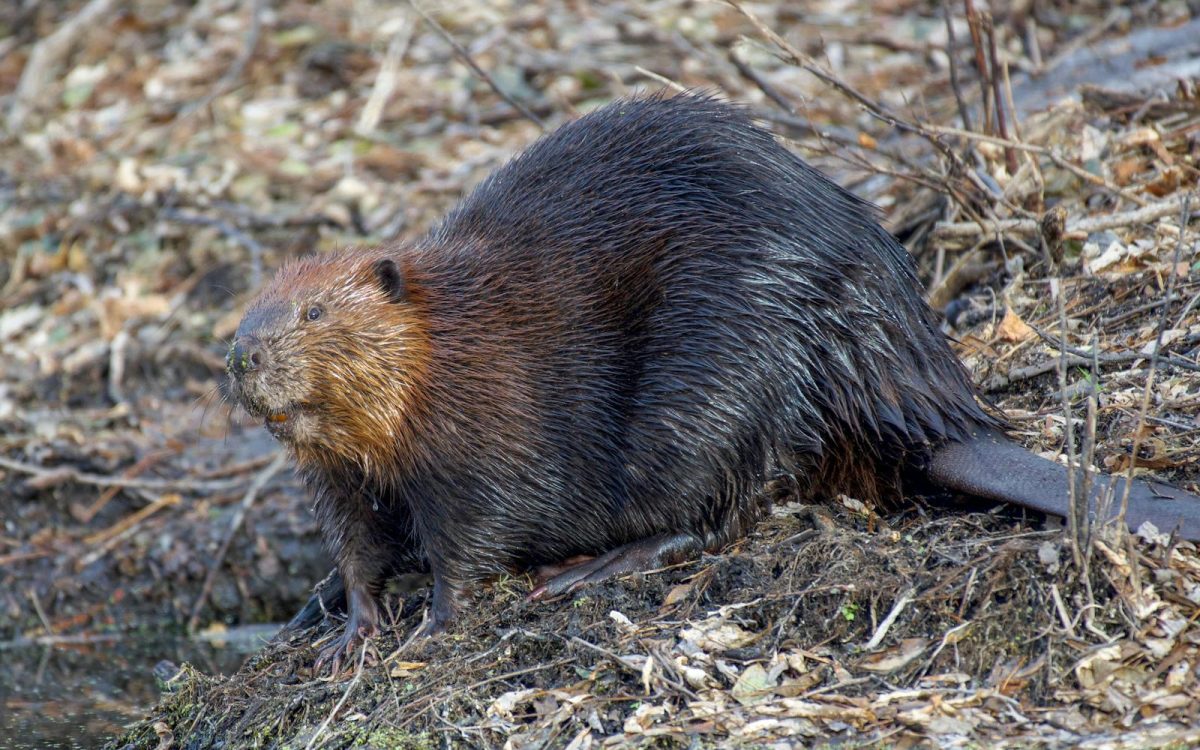
Not all keystone species are predators. Beavers are perhaps the clearest example of what ecologists call an ecosystem engineer, a species that physically transforms the habitat around it.
A single beaver family can flood several acres of forest by blocking a stream. That sounds destructive, but the pond they create becomes habitat for fish, waterfowl, amphibians, insects, and riparian plants. The flooded wood stores carbon. The wetland filters pollutants from agricultural runoff before water reaches larger rivers. In dry seasons, beaver ponds maintain water flow downstream when surrounding streams would otherwise run dry.
When beavers were trapped out of most of Europe and North America by the fur trade, wetland habitats shrank dramatically. The dry land that replaced beaver ponds was more prone to drought, flooding, and erosion. Reintroduction projects in the UK and parts of Europe have shown, within just a few years, measurable improvements in water quality and biodiversity around restored beaver territories.
Keystone Plants and the Animals That Depend on Them
Animals take most of the attention in keystone discussions, but plants and even fungi can hold the same structural role. In tropical forests across Africa, Asia, and South America, fig trees of the genus Ficus fruit year-round while most other trees fruit seasonally. During the lean months between fruiting seasons, figs are often the only reliable food source for fruit-eating birds, bats, primates, and large mammals like forest elephants and tapirs.
Fruit-eating animals are also seed dispersers. If the figs disappear, those animals lose their bridge-food during lean seasons, populations crash, and the seeds of dozens of other tree species lose their primary dispersal agents. The forest composition shifts over time. Researchers in Borneo estimated that more than 1,200 animal species rely on fig trees at some point in their diet. That dependency makes figs a keystone in the fullest sense, not through predation or physical engineering but through sheer food-web centrality.
How Ecologists Identify a True Keystone
The term keystone species gets used loosely in popular writing. Every charismatic animal in a nature documentary seems to carry the label these days. The scientific standard is stricter. A genuine keystone must show a disproportionate impact, meaning its effect on the ecosystem is far greater than you would expect from its biomass or population size alone.
Testing that requires either careful removal experiments, like Paine’s sea star work, or natural comparisons between equivalent habitats with and without the species. Long-term monitoring matters because some cascade effects take years to become visible. The Yellowstone wolf data, for example, was collected and debated over more than two decades before a broad scientific consensus formed.
It is also worth noting that keystoneness is not a permanent title. An animal can be a keystone in one habitat and have an ordinary role in another. Sea otters are keystones in kelp-forest coastal ecosystems but would have a different ecological role in a freshwater lake. Context is everything.
For a broader look at how the removal or addition of specific species affects the flow of energy through nature, the article on food chains and food webs connects directly to the cascade effects described here.
Why This Matters for Conservation Decisions
Recognising keystone species has practical consequences for how limited conservation money gets spent. Protecting a keystone often delivers more ecological return per pound invested than protecting a species with a smaller systemic role, because restoring one keystone can trigger recovery across dozens of dependent species simultaneously.
That is not an argument to ignore non-keystone species. Every species has its own intrinsic value. But when planners must prioritise, keystone status is a legitimate criterion. The reintroduction of wolves to Yellowstone cost a fraction of what a species-by-species recovery programme for all the animals that subsequently benefited would have cost. The wolves did much of the work themselves.
The lesson the keystone concept teaches, more broadly, is that ecosystems are not simple collections of independent species. They are webs of dependency, and some threads in those webs are load-bearing. Pull the wrong one and the whole structure shifts in ways that can take decades, or in some cases may never fully, reverse. Knowing which threads bear the most weight is some of the most important work in ecology today.