Anúncios
Every autumn, a small bird called the willow warbler leaves the birch scrub where it raised a family somewhere in Scotland, and flies to sub-Saharan Africa. It weighs about eleven grams. The journey is roughly 7,000 kilometres. It crosses the Sahara in a single non-stop stretch of two days and nights. It has never made the trip before. It carries no map, has no guide, and will arrive within a few days of where its parents wintered. Then, in spring, it turns around and comes home.
What Migration Actually Is
Animal migration is a regular, seasonal, directional movement between two or more areas, driven by the need to track seasonal resources or reach specific breeding sites. It is distinct from simple dispersal, which is a one-time movement away from a birthplace, and from opportunistic wandering in search of food. Migration has a predictable rhythm, a departure trigger, a route, and a destination.
Anúncios
The triggers are usually environmental cues. Changing day length is the most reliable signal in temperate regions. As days shorten in late summer, many birds experience hormonal changes that drive restlessness, appetite, and orientation toward their migration direction. Day length is a more reliable cue than temperature, which fluctuates, making it a safer internal clock for timing a journey that must match the distant destination’s seasonal changes.
Some species respond to rainfall rather than light. Wildebeest in East Africa follow the rains and the grass growth they produce, circling the Serengeti in a pattern shaped by where green pasture is available at any given month. There is no fixed destination; the migration tracks a moving resource across a very large landscape.
Anúncios
The Astonishing Range of Migrating Animals
Migration is not confined to birds, though birds provide the most visible examples. It occurs across an extraordinary range of animal groups.
Humpback whales travel from polar feeding grounds to tropical breeding grounds, covering thousands of kilometres each way. The routes are consistent enough that researchers can track the same individuals year after year. Pacific salmon navigate from ocean feeding grounds back to the exact freshwater stream where they hatched, guided by an olfactory memory of the chemical signature of their home river.
Monarch butterflies in North America make a multi-generational journey. No individual completes the full round trip. The butterflies that leave Mexico in spring and head north will die somewhere in the middle of the continent. Their children, or grandchildren, continue northward through summer. Then a special long-lived generation, called the migratory generation, makes the full journey south to the same Mexican forests their great-grandparents left months earlier. The route is encoded in their genetics rather than learned from experience.
Among less celebrated migrants, dragonflies cross continents. Christmas Island red crabs make a mass migration to the sea to breed each year. Bar-tailed godwits fly non-stop from Alaska to New Zealand, the longest known non-stop migration of any animal, covering 12,000 kilometres over eleven days without landing.
How Migrating Animals Navigate
The navigation of migrating animals remains one of the most studied and still partly mysterious areas of biology. The tools used are varied and often redundant, which is what you would expect from a system where failure means death.
Magnetic sensing is now well established in many species. Birds have structures in their eyes and brains that respond to the direction and inclination of Earth’s magnetic field, giving them an internal compass that works day or night, in cloud or fog. Turtles, salmon, and some insects also use magnetic cues.
Birds also use the sun as a compass during the day, and stars at night. Young birds of many species spend their first autumn memorising star patterns around the celestial pole, which gives them a fixed north reference that they will use for the rest of their lives.
Smell matters more than is often recognised. Pigeons use airborne odour maps of familiar landscapes. Seabirds such as shearwaters use smell to locate their burrows on dark islands in total blackness. For salmon, smell is the primary mechanism, allowing them to identify the specific chemical profile of their natal stream from hundreds of kilometres away.
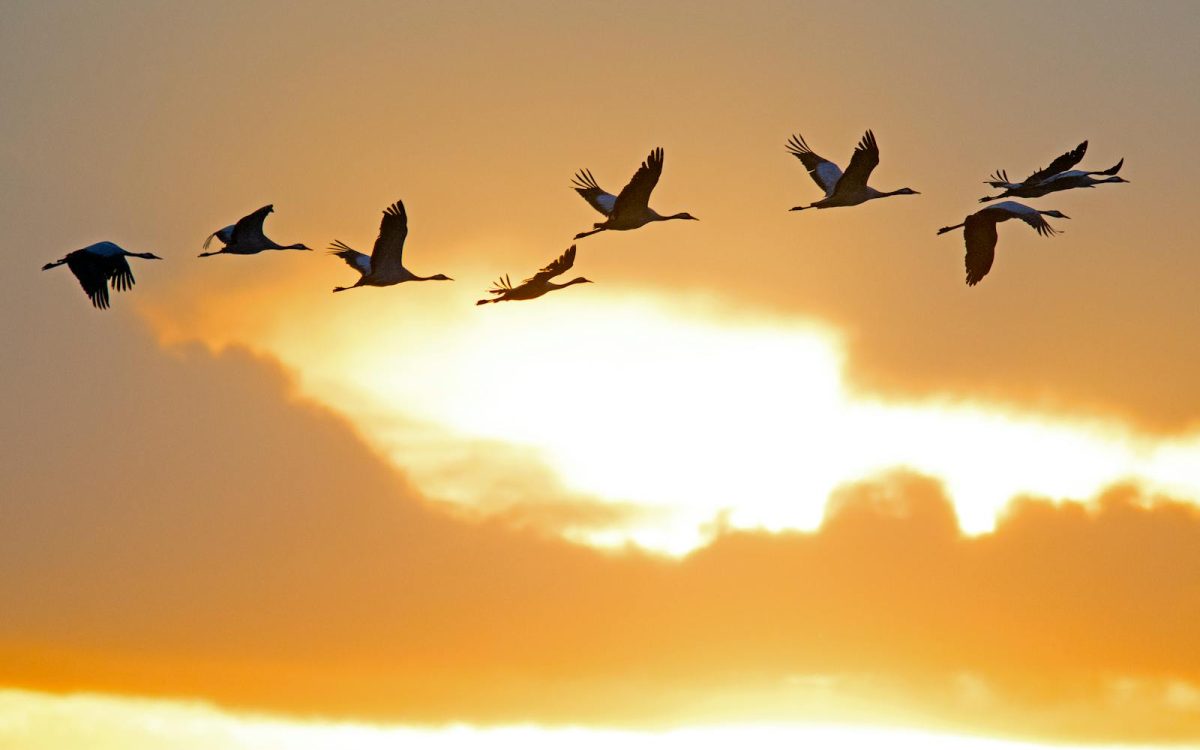
Many species also learn from experience. Young birds often migrate with adults on their first trip, absorbing landmarks and route details they will use independently in later years. Geese and cranes are classic examples, where family groups migrate together and young birds learn both route and destination by following parents.
The Costs and the Calculations
Migration is expensive. A bird crossing the Sahara may lose a third or more of its body weight. Some individuals die of starvation, exhaustion, or predation en route. Migrants are often taken by falcons and hawks that time their own movements to intercept predictable streams of smaller birds at strategic bottlenecks.
Given these costs, why does migration persist? Because in most cases the benefit of reaching better resources outweighs the cost of the journey. A swallow spending winter in Europe would struggle to find enough flying insects to survive. By flying to Africa, it accesses a year-round supply. The calories lost in flight are recovered rapidly once good feeding begins. Over evolutionary time, the birds that migrated outcompeted those that stayed, and migration became fixed in the population.
The calculation is finely balanced. When the cost of migration rises, for example because stopover sites are destroyed and refuelling becomes difficult, or because climate change shifts the timing of food at the destination, migrants can find themselves at a disadvantage. Partial migration, where some individuals migrate and others stay, is thought to be a hedging strategy that keeps both options available within a population when conditions are variable.
Stopover Sites: The Hidden Heart of Migration
Most people, when they think about migration, think about the start point and the destination. But the journey depends just as critically on the places in between. Migrating birds must feed and rest along the route, replenishing the fuel reserves that will carry them to the next stage.
Stopover sites, estuaries, wetlands, coastal scrub, forest edges, and even garden shrubs, are the refuelling stations of the migration network. Lose them and the chain breaks. A migrant that cannot refuel adequately at a stopover may arrive at its destination too weak to breed successfully, or may not arrive at all.
Some stopover sites are irreplaceable. The mudflats of the Yellow Sea in East Asia are the primary stopover for millions of shorebirds migrating along the East Asian-Australasian Flyway. Much of that mudflat has been reclaimed for development. The effect on the birds using those flyways has been severe. Population counts for several shorebird species that depend on Yellow Sea stopovers have fallen dramatically in recent decades, even when conditions at their breeding and wintering grounds appear unchanged.
This is why habitat loss anywhere along a migratory route affects the whole population. Protecting breeding grounds is not enough if the stopovers disappear.
How Climate Change Is Disrupting Migration Timing
Migration timing evolved to match seasonal conditions at both ends of the journey and along the route. Spring migrants return to their breeding grounds when insect abundance peaks. That abundance is closely tied to temperature and plant phenology. As springs become warmer earlier, plant growth and insect emergence are advancing. But many migrants are still arriving on the same schedule they used before temperatures shifted.
The result is a mismatch. A pied flycatcher arriving in a Dutch woodland in the 1970s found peak caterpillar abundance about two weeks after its arrival. Today, that peak arrives earlier, closer to or before the bird’s arrival date. Flycatchers nesting in areas with the largest mismatch are raising fewer young. The birds cannot easily adjust their departure date from West Africa based on what is happening in Dutch woodland three thousand kilometres away.
Some species are proving more adaptable than others. Short-distance migrants, which winter closer to their breeding grounds and may have more direct cues about northern conditions, are shifting their timing faster than long-distance migrants that winter in different hemispheres. This is already changing the composition of breeding communities in temperate regions.
Where Migration Touches Your Own Life
Migration brings distant places into contact with your local patch. The swallows in a barn in rural England spent last winter in the skies over South Africa. The wheatear passing through a coastal headland in September hatched on a Greenland clifftop. The osprey fishing a local reservoir spent six months on a West African river. Their presence connects your local landscape to ecosystems thousands of miles away.
That connection works in both directions. What happens to a wetland in West Africa affects how many swallows return to northern barns. What happens to the insect fauna of a Sussex garden affects whether those same swallows have enough food to raise a second brood. Migration makes the world smaller and makes every landscape part of a larger responsibility.
If you want to support migrating animals in a practical way, the most useful steps are often local: keeping garden lighting low in autumn, providing dense shrubs that migrants can shelter and feed in, and supporting the protection of estuaries and wetlands that serve as stopover sites. You can also read about how animals choose habitats to better understand what makes a stopover site worth stopping at. The great journeys depend on an unbroken chain of places worth pausing in.