Anúncios
Most of us learned it from a trusted adult at a young age, delivered as simple protective wisdom: do not touch a baby bird because the mother will smell your scent and reject it. The advice seemed to make sense. It discouraged children from handling wild animals unnecessarily, which is a reasonable goal. The problem is that the core claim, that birds detect human scent and respond by abandoning their young, does not accurately reflect how birds work. And clinging to the myth sometimes causes real harm, by persuading people to leave birds alone when those birds actually need help.
Why the Touching Baby Birds Myth Spread
The myth probably spread for understandable reasons. Before wildlife rehabilitation was widespread and before most people had access to advice about found animals, the safest general guidance was: do not interfere. A blanket prohibition on touching wildlife, backed by a memorable consequence, accomplished that goal even if the stated mechanism was invented or confused.
Anúncios
There may also have been some generalization from mammals. Many mammals do have sensitive noses and do respond to unfamiliar scents. Does, for instance, will sometimes show wariness toward a fawn that smells of humans, though documented cases of true abandonment from a single brief handling are rarer than the myth implies even there. The leap from mammal behavior to bird behavior was probably not deliberate, but once the claim existed, it applied across categories without distinction.
The rule also had a certain poetic logic: touch the wild, and the wild rejects you. It encoded a kind of respect for wildness that felt morally appropriate. Good intentions do not make biology accurate, though, and this particular piece of misinformation has sent many healthy birds into wildlife rehabilitators unnecessarily, while leaving others on the ground when they genuinely needed help.
Anúncios
What Birds Can and Cannot Smell
The central claim of the myth rests on birds smelling human scent and responding to it. Most familiar garden and woodland birds have a distinctly limited sense of smell. Their olfactory bulbs, the brain structures that process scent information, are small relative to brain volume compared with mammals. Robins, blue jays, house sparrows, starlings, most warblers, finches, and the songbirds you are most likely to encounter in your yard or local park are primarily visual and auditory animals. They navigate by sight, communicate by sound, and their world is largely constructed from those two senses.
This does not mean birds are completely anosmic. Some bird families have well-developed olfaction. Vultures, particularly the turkey vulture, use smell to locate carrion, which is unusual among birds and was for a long time disputed before being established clearly. Seabirds in the order Procellariiformes, including petrels and shearwaters, use scent to locate food over open ocean and to navigate back to nesting colonies. Kiwis in New Zealand locate invertebrates underground using scent, a remarkable adaptation. Pigeons may use olfactory cues in navigation.
But the birds that produce the baby bird encounters most people experience, the nest in the hedge, the fledgling on the lawn, the nestling fallen from a tree, these are species whose scent detection is too limited to register a brief human handling as a meaningful threat. The olfactory equipment for the myth’s mechanism simply is not there.
How Parent Birds Actually Respond to Disturbance
Parent birds are strongly motivated caregivers. The investment in egg incubation and chick feeding is biologically costly, and evolution has selected strongly for parents who persist through disturbance rather than abandoning young at the first sign of difficulty. A bird that abandoned its nest every time something touched or moved near it would leave few surviving descendants.
What parent birds respond to is primarily threat, not scent. A hawk circling overhead will prompt alarm calls and may cause adults to stop returning to the nest temporarily. A predator near the nest site may trigger mobbing behavior or strategic absence to avoid leading the predator to the young. But these are responses to visual or auditory threat cues, not to the chemical residue left by a human hand on a chick’s feathers.
Research consistently bears this out. Ornithologists and field biologists who ring and band nestlings as part of monitoring programs handle young birds regularly and return them to nests as a matter of course. Nests monitored in this way continue to show normal parental behavior with the same consistency as unhandled nests. If the touching-causes-rejection claim were true, decades of banding research would have produced a pattern of abandonment. It has not.
Nestlings and Fledglings: Very Different Situations
Part of what makes this myth specifically harmful is that it causes people to hesitate in situations where action would genuinely help. To respond appropriately to a bird on the ground, it helps to know which developmental stage you are looking at.
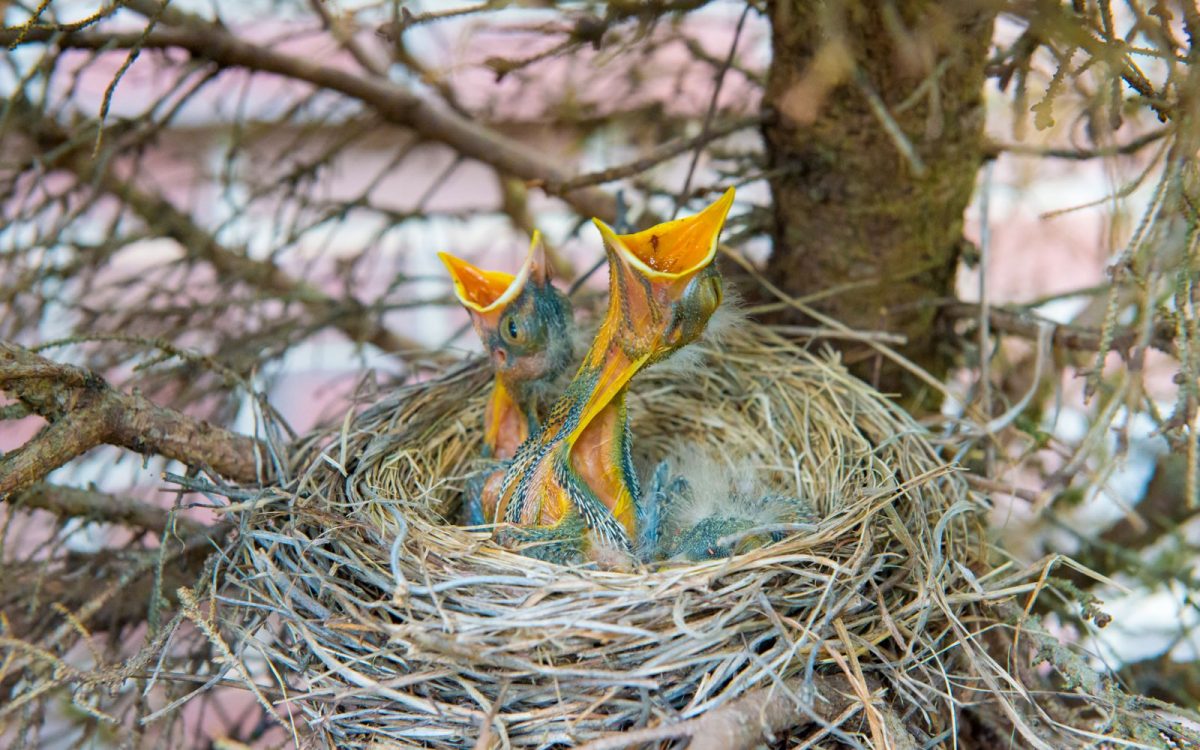
A nestling is a young bird that has not yet reached the stage of flight. It may be naked, or covered only in sparse down, or have pin feathers just emerging. Its eyes may be closed or only partially open. It is entirely dependent on its parents for warmth and food and cannot regulate its own body temperature. A nestling on the ground has fallen prematurely and does need to be returned to its nest if possible. If the nest is within reach and intact, placing the bird back is the right action, and will almost certainly not result in abandonment.
A fledgling is a different matter entirely. Fledglings have visible feathers, can usually hop or short-hop-fly, and are in a normal developmental phase that involves spending time on the ground. Many species have a ground phase lasting several days during which they are fed by parents but practice movement and flight without the safety of the nest. A fledgling sitting on a lawn or path is usually not in danger. Its parents are typically nearby, watching and calling but staying away from your presence.
The instinct to scoop up any bird found on the ground and bring it inside is well-meaning but usually wrong. Observation from a distance for thirty to sixty minutes is almost always the better first step. You will often see parents making feeding visits if you watch patiently from a respectful distance. You can also find guidance on how to assess injured wildlife in our article on what to do if you find an injured wild animal.
When Handling Does Help
There are situations where picking up a bird is genuinely the right response. A naked nestling on cold ground cannot survive for long without warmth, and returning it to its nest is appropriate. If the original nest is destroyed or unreachable, an improvised substitute nest placed near the original site, made from a small container with dry nesting material, can work. Parent birds locate their young primarily by their calls, not by their specific position in the original nest structure. They will often adopt the substitute if it is placed in approximately the right area.
A cat attack is one situation where immediate action is strongly warranted even if the bird looks uninjured. Cats carry bacteria in their saliva and claws, including Pasteurella multocida, that can cause fatal infection in birds within 24 to 48 hours of exposure. A bird grabbed by a cat, even briefly, should be assessed by a wildlife rehabilitator. The external wound, if any, tells you almost nothing about the internal contamination.
For any bird that is clearly injured, disoriented, or not being attended to by parents after two hours of observation, contact a licensed wildlife rehabilitator. They have the training and the legal authorization to provide appropriate care. In North America, possession of most wild birds without a license is a federal offense under the Migratory Bird Treaty Act, so the goal should always be to connect an animal in trouble with someone qualified to help it, not to take on the care yourself. You can find local rehabilitation contacts through your state or provincial wildlife agency website.
Teaching the Better Version to Children
The reason the myth persisted is that the lesson underneath it, give wild animals space and do not handle them unnecessarily, is a good one. Children need to learn that their hands can cause harm even when their intentions are kind. The myth tried to teach that lesson through a memorable story. It just used bad biology to do it.
A more accurate version is not harder to teach: wild animals experience handling as frightening and stressful, even if they are not harmed by it. They belong in their world, not in ours, and except in genuine emergencies, observation from a respectful distance is better for them than contact. Birds do not reject their young because they smell a human. But they do deserve the peace of not being touched unless there is a real reason to help.
If a fledgling is hopping across your garden path, taking a moment to watch quietly from a distance is likely to reward you. The parents may not be visible, but they are probably close. What looks like abandonment from fifteen feet away is often careful, watchful, patient parenting from just out of sight. That patience is something worth respecting, even if the myth that taught you to respect it turned out to be wrong about the mechanism. You can learn more about how birds raise their young in our overview of animal life cycles from egg to adult.