
Anúncios
Most people have heard the distinctive thud of a bird striking a window. Some have found a small body on the ground beneath one. The experience is jarring, and the instinct is to want to prevent it from happening again. The solutions exist, they are affordable, and many of them can be applied in an afternoon without any special tools. The key is understanding exactly why birds hit glass, because that explains why some common fixes do not work and others do.
Why Birds Cannot See Glass as a Barrier
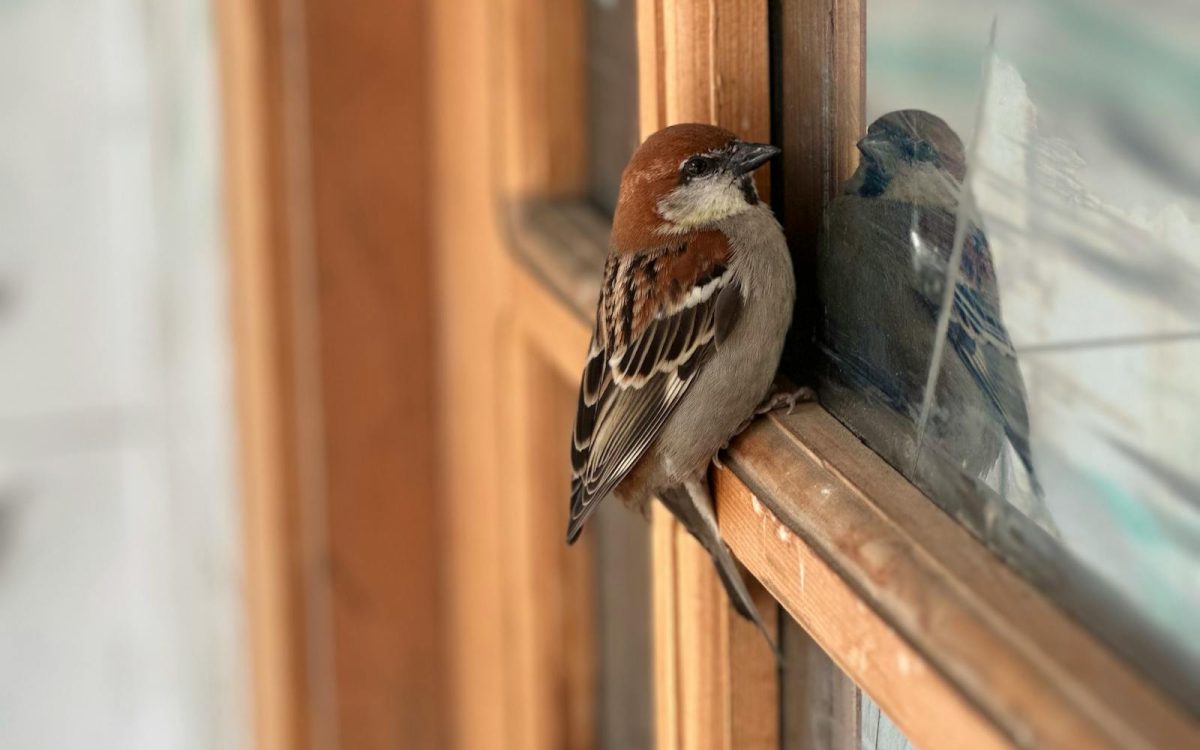
A window that reflects a tree, a bush, or an open stretch of sky presents no visible obstacle to a bird in flight. What the bird sees is habitat or open space — and it aims for that. Glass-reflected environments are often clearer and more vivid than the actual environment behind the bird, making the illusion particularly convincing.
Anúncios
A second scenario is equally common: birds can sometimes see straight through a glass pane, especially in a house with windows on opposite walls. The bird perceives a flight path through the home, aims for the apparent exit, and strikes the near pane. Large picture windows, French doors, and glass-walled corners are especially prone to this because of the strong visual passage they create.
Night adds a third collision mechanism. Artificial indoor lighting attracts migrating birds, which navigate partly by celestial cues. Bright windows pull birds toward buildings during peak migration months, and the resulting collisions kill in large numbers during the spring and fall migration windows.
Anúncios
What Actually Works: The 2×4 Rule
The consistent finding from window-strike research is that breaking up the apparent continuity of a glass surface prevents collisions. The American Bird Conservancy’s 2×4 rule states that markings applied to glass should be no more than 2 inches apart vertically or 4 inches apart horizontally. Any gap larger than this appears to a bird as a passable opening, because birds judge whether they can fly through a space based on their body size, and most songbirds are smaller than a 4-inch clearance.
This rule immediately explains why single hawk silhouette stickers are ineffective. One sticker covering a few square inches of a large window leaves the vast majority of the surface unmarked, with wide gaps on all sides. The bird sees open glass, not a barrier. Multiple stickers spaced according to the 2×4 rule would work — but in practice, covering a window with dozens of individual stickers is neither convenient nor aesthetically acceptable to most homeowners.
Practical Solutions for Every Window Type
Several product categories apply the 2×4 rule in ways that are practical for home use.
Window films and frosted treatments are among the most effective and aesthetically clean solutions. Films designed specifically for bird-strike prevention apply to the outside of the glass and are nearly invisible from indoors, preserving your view, while creating a pattern that birds can perceive. Brands such as CollidEscape and the American Bird Conservancy’s own BirdTape products are widely available and easy to apply. For a less expensive approach, frosted or etched window film available at hardware stores achieves similar results if applied at adequate density.
Exterior screens, installed on the outside of windows and held a few inches away from the glass surface, are highly effective because they eliminate both the reflection and the transparency problem simultaneously. They also catch stunned birds before they fall to the ground. The limitation is installation complexity and cost for large or awkward windows.
Tempera paint or chalk markers applied in a grid pattern work well on windows that do not need to be transparent from the outside — such as garage windows or workshop glass. They wash off with water and can be reapplied each season.
For sliding glass doors and large picture windows, hanging vertical strings or paracord at 2-inch intervals on the outside face of the glass is a proven, inexpensive solution. The cords move slightly in the wind, which increases their visibility, and the spacing meets the 2×4 threshold. Some homeowners object to the visual effect, but the cords are barely noticeable from a normal indoor viewing distance.
Feeder Placement Is a Key Variable
Feeders placed very close to windows — within 3 feet — or very far from windows — beyond 30 feet — produce fewer collisions than those placed at an intermediate distance. The logic is that a bird launching from a feeder 3 feet away does not build enough speed to cause fatal injury if it strikes the window. A bird 30 feet away has enough warning to register the reflection as an obstacle and veer away. It is the 5-to-15-foot range that accounts for most feeder-related strikes, because the bird reaches significant speed before encountering the glass.
If you maintain a feeder, check its distance from your nearest window and adjust accordingly. This single change reduces collision rates for many households without requiring any treatment to the glass itself. The guide on feeding backyard birds responsibly covers other feeder-related considerations, including seed choice and cleaning schedules, that are worth addressing at the same time.
Addressing the Night Migration Problem
For households in the flight paths of migratory species — which includes most of North America — light management during migration season is one of the most effective interventions available. The Lights Out programs run by the American Bird Conservancy and various city-level initiatives ask building owners to turn off non-essential lighting during peak migration nights.
At home, the practical version is to turn off lights in rooms that face north or east — the primary approach corridors for northbound migrants — during April and May, and to repeat the practice in August through October for southbound migration. Heavy curtains or window shades pulled closed in lit rooms accomplish the same thing. Even partial light management in a residential neighborhood can reduce collision rates meaningfully at the local level.
A Real-World Troubleshooting Scenario
Suppose you have a large bay window facing a garden, and you find a bird stunned or dead beneath it two or three times each spring. The window reflects the hedge and the sky behind you. You do not have a feeder nearby. The problem is almost certainly reflection, and the solution is to address the outside surface of the glass during the spring migration period.
Apply a bird-deterrent window film to the outside face of the bay window, following the 2×4 spacing. If the window opens, an exterior screen set 2 to 4 inches off the glass is an even more complete solution. If you prefer a seasonal treatment, a grid of 2-inch strips of painter’s tape on the outside glass during April and May gives you the protective spacing while costing almost nothing. The tape peels cleanly when migration season ends.
After a Bird Strikes Your Window
When a bird hits your window and lands stunned, the appropriate response is to give it quiet time to recover before assuming it needs intervention. Place the bird in a paper bag or a small cardboard box, close it loosely, and keep it somewhere warm, dark, and quiet — away from pets and from temperature extremes. Many birds recover from mild concussive strikes within 30 minutes to two hours and can be released without further intervention.
If the bird shows no recovery after two hours, or if it was clearly killed by the impact, contact a local wildlife rehabilitator. A stunned bird with a spinal or brain injury may look superficially similar to a recovering bird for the first hour, and professional assessment is warranted when the timeline extends. For more guidance on that handoff, the article on what to do if you find an injured wild animal walks through the containment and contact steps in detail.
Window strikes are preventable, and the prevention tools are within reach for most homeowners. Applying a film or installing strings on your most problematic windows this season may not seem like much, but across a neighborhood or a city, that kind of household-by-household action adds up to tens of thousands of birds spared each year. It is among the most direct things you can do to reduce your home’s impact on local bird populations without changing how you live.