Anúncios
In the mountains of southern California, a mountain lion known to researchers as P-22 spent most of his adult life in Griffith Park, a 1,700-hectare urban park in the middle of Los Angeles. He had crossed two of the busiest freeways in North America to get there as a young animal, a crossing that few of his kind attempt and fewer survive. Once inside the park, he could not get out. There were no females. There was no future.
P-22 became famous, then beloved, and his situation put a spotlight on one of the central challenges in modern conservation: the landscape is broken up, and the pieces have trouble communicating with each other. Wildlife corridors are the answer ecologists and engineers have developed for that problem. P-22 himself prompted the largest wildlife crossing project in the world, a vegetated overpass being built across the 101 Freeway in the Agoura Hills west of Los Angeles, designed to reconnect mountain lion populations that have been genetically isolated for decades.
Anúncios
Why Connectivity Matters So Much
The theory behind wildlife corridors draws on a body of ecological work called island biogeography, developed by E.O. Wilson and Robert MacArthur in the 1960s. They studied oceanic islands and found that the species richness of an island was predicted by two factors: how large it was, and how far it sat from the nearest other land. Larger islands held more species. More isolated islands held fewer.
Ecologists quickly realised that the same principles apply to habitat patches surrounded by human-modified land. A forest fragment in an agricultural landscape is, ecologically speaking, an island. It loses species over time unless it can exchange individuals with other fragments. The local extinction of a particular bird or frog is not replaced unless a new individual can reach the patch from somewhere else.
Anúncios
Connectivity restores that exchange. When individuals can move between patches, local populations can be rescued from decline by arrivals from healthier populations elsewhere. Genetic diversity is maintained because individuals are not forced to breed only within a small isolated group. And when climate change shifts conditions in one patch, species can shift their range by moving through connected habitat rather than facing a lethal crossing through parking lots and highways.
What Wildlife Corridors Look Like in Practice
Corridors take many forms depending on the landscape, the target species, and the resources available. The widest and most ecologically complex are landscape corridors: broad stretches of natural or semi-natural habitat that connect larger reserves. The Yellowstone to Yukon Conservation Initiative, which aims to maintain ecological connectivity along the entire Rocky Mountain chain from Wyoming to the Yukon, is one of the most ambitious examples anywhere.
At a smaller scale, riparian corridors, the strips of vegetation along riverbanks and stream edges, naturally link habitats across agricultural and urban landscapes. Rivers have always been movement routes for wildlife, and protecting or restoring their banks is one of the most cost-effective corridor interventions available. A shaded, vegetated stream edge benefits water quality, reduces flood risk, and provides a travel route for dozens of species simultaneously.
In intensively farmed landscapes, hedgerows serve as corridors for hedgehogs, dormice, bats, and farmland birds. Traditional mixed farming landscapes in Europe maintained dense networks of hedgerows that connected patches of woodland across entire regions. The removal of those hedgerows over decades of agricultural intensification is one reason why farmland birds and small mammals have declined so sharply in Britain and western Europe.
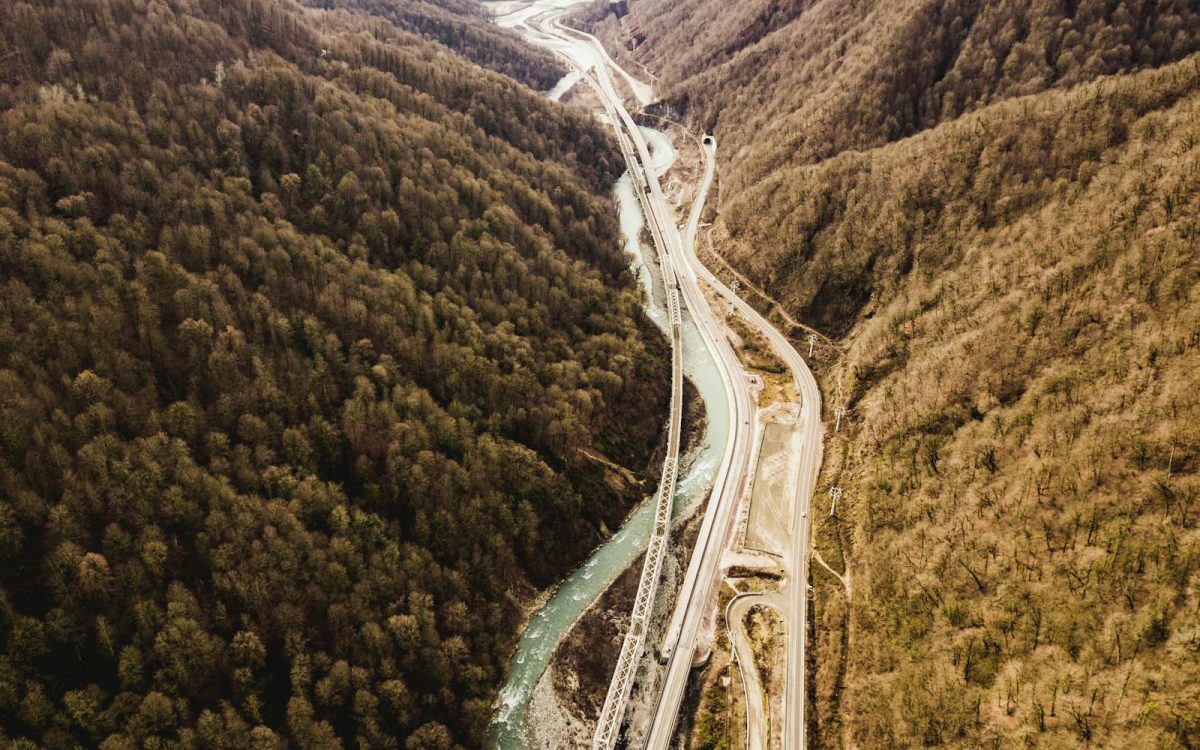
Road crossings are among the most engineered forms of corridor. Culverts and underpasses allow amphibians, badgers, and small mammals to pass beneath roads safely. Larger underpasses accommodate deer, bears, and medium-sized carnivores. The biggest crossing structures are wildlife overpasses, wide bridges planted with native vegetation that provide natural cover above the roar of traffic below. Banff National Park in Canada installed a series of these crossing structures on the Trans-Canada Highway in the 1990s and has documented their use by wolves, grizzly bears, elk, and numerous other species through camera trap monitoring.
Designing Corridors That Actually Work
Not all corridors are equally effective, and a poorly designed one can waste significant resources. Several design principles have emerged from research.
Width matters enormously. A narrow corridor acts more as a movement channel, useful for getting from A to B but not providing enough interior habitat to support populations of species sensitive to edge effects. Edge effects are the influences that penetrate from the disturbed land around a corridor into its interior: increased predation, invasive species, altered microclimate, noise. For interior forest birds and mammals, a corridor needs to be wide enough that its centre is meaningfully different from its edges.
The quality of the habitat within the corridor matters as much as its width. A green bridge planted with turf grass serves far fewer species than one planted with native shrubs and trees. An underpass surrounded by bare concrete and lit from above will be used by far fewer animals than one with natural substrate, low lighting, and native vegetation at its entrances.
The landscape context around a corridor determines much of its value. A corridor connecting two small, degraded fragments provides less benefit than the same corridor connecting two large, high-quality habitat patches. Conservation planning increasingly looks at whole connected networks of habitat rather than individual pieces, asking where the most critical bottlenecks are and what interventions would most improve overall connectivity.
Corridors and Climate Adaptation
One of the strongest arguments for wildlife corridors right now is their role in helping species shift their ranges as climate zones move. Species are already moving poleward and uphill in response to warming, and those movements will continue and accelerate. For many species, the critical question is not whether conditions will become suitable elsewhere, but whether they can reach that elsewhere.
Species already under pressure from habitat loss are disproportionately at risk from climate-related range shifts because they have the fewest remaining options. A corridor that allows a butterfly species to track its shifting host plant up a mountainside, or allows a salamander to reach a cooler, higher watershed, may be the difference between local persistence and local extinction.
Climate-forward corridor design tries to anticipate these movements rather than simply connecting existing habitat. It identifies areas that are likely to remain climatically suitable for target species further into the future and prioritises connectivity toward those refuges.
Corridors at the Community Scale
Large-scale corridor initiatives require government policy, landowner cooperation, and significant funding. But the principle scales down to neighbourhoods and gardens.
In the UK, the People’s Trust for Endangered Species has documented the importance of garden connectivity for hedgehogs, which are in steep decline. Hedgehogs need large foraging territories but cannot cross impermeable fences. The simple act of cutting a 13-centimetre gap at the base of a fence, enough for a hedgehog to pass through, can link a neighbourhood into a navigable network. The ‘Hedgehog Street’ campaign has registered tens of thousands of such gaps across the country.
Making your own outdoor space more wildlife-friendly contributes directly to neighbourhood-level connectivity when your neighbours do the same. A single garden with a pond, native planting, and no pesticides is good. A connected network of twenty such gardens across a few streets is meaningfully better for the amphibians, invertebrates, and small mammals trying to move through an otherwise hostile suburban landscape.
The Bigger Picture
Wildlife corridors are not a substitute for protecting and restoring the large habitat patches they connect. A corridor between two degraded fragments does limited good. The most powerful conservation outcomes come from combining large, well-protected core areas with functional connectivity between them, and with the broader landscape managed in ways that at least tolerate wildlife movement.
P-22, the mountain lion of Griffith Park, died in late 2022 from injuries sustained after being struck by a vehicle, having spent twelve years in that beautiful, bounded park. The freeway crossing that bears his legacy is now partially complete. When it opens, mountain lions from the mountains north of Los Angeles will have a real path to populations in the south, and the next P-22 will not have to live his life on an island.
That crossing took decades of advocacy, research, and fundraising to build. But it will be there, spanning the highway, for a very long time.