Anúncios
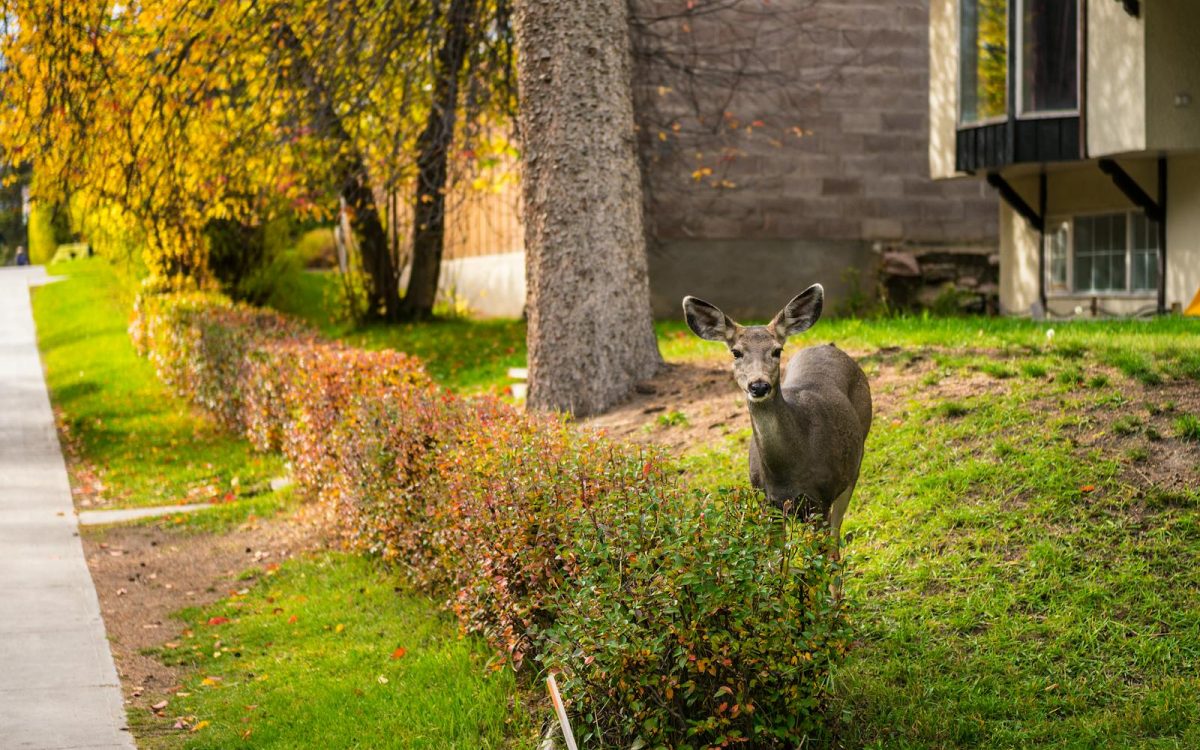
A group of white-tailed deer moves across a suburban lawn in the grey light of early morning, pausing to graze the ornamental hostas before drifting back into the tree line. For the homeowner watching from the kitchen window, the reaction depends entirely on which plants those are. Deer in residential neighborhoods are a fixture across North America and are becoming more common in many parts of the UK and Europe as populations have expanded into edge habitats. Learning to manage that relationship takes patience rather than aggression, and the results are gardens and streets that work for both people and deer.
Understanding Why Deer Enter Neighborhoods
Deer in neighborhood settings are not lost or confused. They are following routes that their instincts and memory tell them lead to food, cover, and safety. Suburban areas often provide exactly those three things. Residential plantings include many species deer find highly palatable, from hostas, roses, and tulips to fruit trees and vegetable gardens. Low or absent fencing makes access easy. Patches of trees, hedgerows, and unmown verges provide the visual cover that deer prefer while moving through open ground. Once deer establish a route, they use it repeatedly unless something interrupts the pattern.
Anúncios
Deer populations across North America have grown significantly over the past century as wolf and mountain lion numbers declined in many regions. Mild winters and the reliable food that suburban landscapes provide have supported that growth further. This is not a problem to be eliminated; it is a feature of the landscape you live in, and the practical question is simply how to share that landscape sensibly.
Protecting Your Garden
The most reliable protection for specific plants or beds is physical fencing. A fence of at least 1.8 metres will deter the large majority of deer in most circumstances, though highly motivated deer, especially in late winter or drought when natural forage is scarce, may attempt taller jumps. For individual valued plants, wire cages or tree tubes are effective and low-cost. Double fencing, two parallel barriers spaced about 1.2 metres apart, exploits deer reluctance to jump into a confined space and can work with barriers as low as 1.2 metres each.
Anúncios
Planting choices make a real difference over the long term. Gardens designed primarily around aromatic herbs, ornamental grasses, thorny shrubs, and plants with strong or bitter flavors naturally receive less deer attention. Lavender, rosemary, barberry, Russian sage, foxglove, and yarrow are all widely available and generally unpopular with deer. Replacing heavily browsed ornamentals with deer-resistant alternatives reduces the need for ongoing intervention. The guide on how to make your yard wildlife-friendly offers useful planting principles that can be adapted to reduce deer browsing while supporting other species.
Repellent sprays based on putrefied egg solids or predator scents can be moderately effective if applied consistently, particularly on young plantings. They need reapplication after rain and lose effectiveness when deer are very hungry. Think of them as a supplement to physical barriers rather than a primary solution.
Deer and Your Vegetable Garden
A vegetable garden without deer protection in deer country is simply a free meal. Deer are drawn to the tender, high-nutrient plants in kitchen gardens and will return nightly once they find one. Full perimeter fencing is the only truly reliable solution for a vegetable plot. If full fencing is not practical, covering individual beds with netting each evening before dusk and removing it each morning provides workable protection during the growing season, though it requires consistent effort. Motion-activated sprinklers placed near garden entrances can discourage nighttime visits.
Avoid planting highly attractive crops like lettuce, beans, brassicas, and sweet corn close to garden boundaries where deer access is easiest. Reserve those for beds in the more central, protected part of your plot. Less attractive vegetables such as squashes, cucumbers, and strong-smelling alliums can serve as a buffer planting at the perimeter.
Road Safety and Deer
Deer-vehicle collisions are one of the most serious consequences of deer in neighborhood settings. In North America, millions of such collisions occur each year, causing billions in vehicle damage and thousands of serious injuries. The highest risk periods are dawn and dusk year-round, and the autumn rut in October and November, when male deer move erratically in search of mates with much less of their usual caution.
Slow down in areas with deer crossing signs, particularly during the first and last hours of daylight. If you see one deer at the roadside, always assume there are more about to follow. Deer rarely move alone. If a deer freezes in your headlights, brake smoothly and sound your horn. Do not swerve sharply, as losing control of the vehicle is a greater risk than a direct collision with the animal. After a collision, pull over safely and contact local authorities; a wounded deer on the road creates a secondary hazard for other drivers.
Interacting With Deer Safely
Deer are not dangerous in the way that carnivores can be, but they are not domesticated animals either, and close approach carries risks, particularly at certain times of year. A doe with a fawn can be surprisingly assertive if she feels her young is threatened. A buck during the October-November rut may be unusually bold and unpredictable. Give all deer a minimum of several metres of space. Never approach a fawn lying alone in a garden; its mother is almost certainly nearby, and the fawn has been deliberately left there while she feeds.
Do not feed deer. The reasoning behind this is covered fully in the piece on why feeding wild animals is usually a poor idea, but the short version is that supplemental feeding concentrates deer, increases disease transmission, causes them to associate human yards with food, and significantly raises the risk of vehicle collisions as deer make repeated road crossings to reach feeding sites.
When Deer Numbers Become a Genuine Problem
In some neighborhoods, deer densities have grown high enough to cause meaningful environmental damage, including overgrazing of forest understories, significant vehicle hazard, and disease pressure within the herd itself. In those situations, individual measures can only go so far. Community-level approaches, including coordinated planting changes, shared fencing schemes for vulnerable areas, and engagement with local wildlife management authorities about population management options, are more effective than any single household acting alone.
If you are concerned about deer density in your area, contact your state or provincial wildlife agency. Managed hunting programs, which exist in most jurisdictions with significant deer populations, are the primary tool used for population management and are carried out by licensed professionals under strict regulations. This is a matter for wildlife authorities, not for individual homeowners to address.
Finding a Workable Balance
A neighborhood that has deer passing through it each day has a living landscape, one connected enough to natural corridors that large mammals can still move through it. That is worth something. The adjustments needed to protect your garden and drive safely are genuinely modest compared to that benefit. Fence what you need to protect, plant what deer find unpalatable, slow down at dawn and dusk, and leave the deer themselves free to do what they have always done. For a broader perspective on coexisting with the many species that share suburban spaces, the calm guide to staying safe around wildlife covers the mindset and habits that make these encounters consistently manageable.
The deer that browse your neighbor’s lawn at first light are not a problem. They are a reminder that the natural world does not stop at the garden gate, and that with a few sensible adjustments, neither side of that boundary needs to lose much sleep over it.