Anúncios
Nearly every journey by car includes passing at least one animal carcass on the roadside, yet the sheer regularity of the sight has made it background noise for most drivers. Roadkill is one of the leading causes of vertebrate wildlife mortality in developed countries, and its effects on populations are cumulative: even modest daily losses on a busy road add up, year after year, to numbers that can genuinely affect local species abundance. Taking a clear-eyed look at why this happens, and what actually makes a difference, is time well spent.
Why Roads Are So Deadly for Wildlife
Roads are not natural barriers in any sense that evolution has prepared animals to recognize. A deer does not perceive a two-lane highway as something categorically different from a grassy clearing. A hedgehog crossing a country road is following the same instinct that led its ancestors safely through open ground for millions of years. The problem is that vehicles appear at speeds and in volumes that have no precedent in any animal’s experience.
Anúncios
Several factors combine to make roads particularly lethal. First, roads are built through habitats specifically because those habitats contain the flat, connected corridors that both engineers and wildlife favor. A road through a river valley follows the valley because it is easy to build and efficient to drive; the same reason every mammal in the area uses that valley as a travel route. The road and the wildlife movement corridor overlap almost perfectly.
Second, animals are most active during the hours humans drive most carelessly. Deer, foxes, badgers, and most large and medium-sized mammals peak in activity at dawn and dusk, precisely when light conditions make them hardest to see and when many drivers are tired, hurrying to work, or returning home with reduced alertness. A hedgehog crossing at 11 p.m. on a rural lane is invisible until it is already within a few meters of the front wheels.
Anúncios
Third, seasonal movements concentrate risk at predictable times. Spring amphibian migrations draw thousands of frogs and toads across the same rural roads on the same few warm, wet nights each year. Deer rut in autumn moves bucks across roads they would ordinarily avoid. Juvenile animals dispersing in late summer cross unfamiliar terrain for the first time and have no experience of traffic at all.
The Cumulative Effect on Populations
Individual losses matter, but the population-level mathematics are where the true concern lies. For slow-reproducing species with low annual survival rates, even modest road mortality can tip a local population into decline. Otters in Europe are a well-studied example: in many regions, road deaths near river crossings account for the single largest identifiable mortality source, and otter populations near busy roads have measurably lower density than those in road-free river systems.
Large raptors such as barn owls and red kites face a similar calculation. A barn owl pair that successfully raises three to four owlets per year and loses one adult to a road strike each year is, across a decade, sustaining a loss that reproduction alone struggles to offset, particularly when habitat quality is also declining. Roadkill is rarely considered in isolation from the other pressures a species faces, but it compounds those pressures in ways that are now well-documented by population biologists.
Roads also fragment habitat in ways that kill animals more slowly. A highway through woodland does not just kill animals in direct collisions; it prevents the movement of animals that will not cross it at all, reducing genetic exchange between populations and making local groups more vulnerable to disease and inbreeding. Wildlife corridors are specifically designed to address this fragmentation problem, and their effectiveness is directly tied to how many road crossings they incorporate.
Infrastructure That Actually Works
The most effective interventions are engineered into roads rather than added afterward, but retrofits can be highly effective as well. The essential principle is simple: give animals a safe way to cross the road without encountering traffic.
Wildlife underpasses range from large concrete tunnels designed for deer and elk down to small culverts scaled for amphibians and small mammals. Their effectiveness depends almost entirely on whether they are paired with barrier fencing that channels animals toward the crossing rather than leaving them free to cross at any point along the road. Underpasses without fencing reduce collisions modestly; underpasses with funnel fencing reduce them dramatically.
Wildlife overpasses, green bridges planted with native vegetation, are more expensive but work for species that resist traveling underground. The network of crossings at Banff National Park in Canada, which includes multiple overpasses spanning the Trans-Canada Highway, has been extensively studied. Collision rates for deer, elk, and wolves dropped by over 80 percent in the years following installation, and camera trap data confirmed that large predators were using the structures regularly.
Seasonal road closures and reduced speed limits at migration hotspots are lower-cost measures with measurable results. Several European countries temporarily close rural roads to vehicles during peak amphibian migration nights, when thousands of frogs and toads cross within a window of just a few hours. Some use volunteer tunnel systems, where helpers collect animals from barrier fences and carry them across by bucket, an approach that sounds improbable but has saved hundreds of thousands of animals at well-organized sites.
What Drivers Can Do Right Now
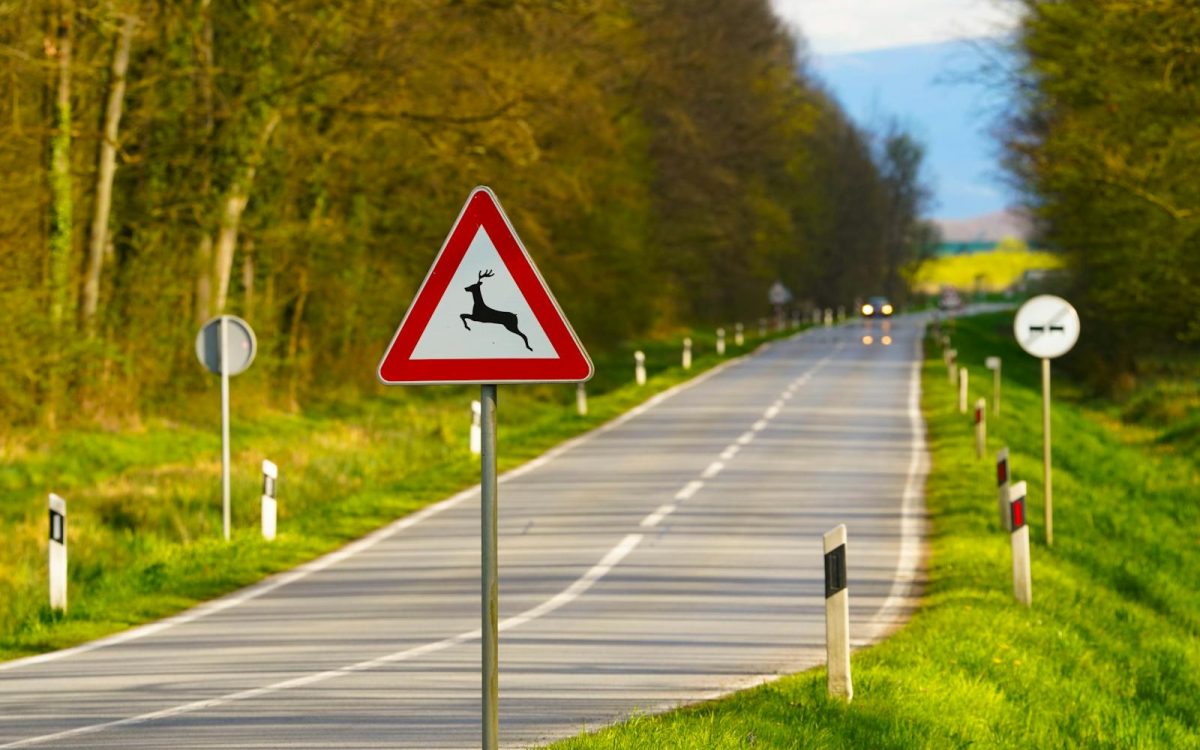
Most drivers are not in a position to advocate for new infrastructure on every road they use, but individual driving choices have real and immediate effects. Slowing down near wildlife warning signs is the single most direct contribution any driver makes. A vehicle traveling at 60 kilometers per hour gives a deer roughly twice the reaction distance compared to one at 100 kilometers per hour, and the probability of a collision being fatal to the animal drops sharply with impact speed.
Scanning road margins rather than just the road surface helps spot animals before they step into the traffic lane. Deer often pause at the road edge before crossing; that pause is your warning. If you see one deer, slow immediately and assume more are behind it. Deer frequently cross in small groups, and the second or third animal often follows the first before a driver has finished reacting to the original sighting.
Scenario: You are driving a rural road at dusk in October, a classic time for deer movement during the rut. Your headlights catch two points of orange eye-shine about forty meters ahead in the road margin. Lifting your foot from the accelerator immediately, covering the brake pedal, and scanning the road ahead for a second animal is the correct sequence. This costs you a few seconds at most and can prevent a collision that would kill the deer and potentially injure you seriously.
Reporting carcasses you observe through citizen-science platforms creates data that feeds directly into infrastructure planning. The locations of road deaths are not uniformly distributed; they cluster at known crossing points, near water, and at gaps in roadside vegetation. That clustering is the information planners need to target interventions where they will have the greatest effect.
What Communities Can Do
Organized mapping of local roadkill hotspots has led directly to infrastructure changes in multiple countries. Local naturalist groups, herpetological societies, and road ecology volunteers have successfully made cases to local transport authorities for speed limit reductions, new warning signs, and underpass installations by presenting systematic data collected over one or two seasons. The process does not require scientific credentials, only consistent, accurate reporting over time.
Advocacy for wildlife-sensitive road design in new construction is increasingly effective, as the evidence base for crossing structures is now strong enough to satisfy cost-benefit analyses that transport agencies routinely require. The article on building wildlife awareness in your community offers practical guidance on organizing local groups and presenting data to decision-makers.
Roads have transformed the landscape in ways that are unlikely to reverse, but their impact on wildlife is not fixed. Infrastructure, driver behavior, and community-level data collection each play a genuine role, and the combination of all three has already transformed specific road sections from death zones into passages animals use safely every night.