Anúncios
There is a particular quality to a winter morning that no other season replicates. The air is clean and still. Sound travels further. A single crow calling from a bare oak carries across the whole of a quiet park in a way that would be swallowed by summer’s fullness. Winter nature does not ask you to work hard to find it; it asks you to pay a different kind of attention than the rest of the year demands.
Why Winter Nature Rewards Beginners
If you are new to watching the natural world, winter is an underrated time to start. The absence of leaves means birds that would be invisible in a full canopy sit in plain sight on bare branches. Animal tracks that warm-season vegetation would obscure appear clearly in mud along stream banks and path edges. Mosses and lichens, almost ignored when they compete with flowers and butterflies, reveal themselves in their full textured variety on walls, bark, and stone.
Anúncios
There is also something settling about winter’s slower pace. You are not competing with the abundance that can feel overwhelming in spring, when everything seems to demand your attention at once. Winter offers one thing at a time, clearly presented. A single fieldfare in a hawthorn. A fresh fox print at the edge of a puddle. A long-tailed tit flock moving through the tops of alders. Each observation feels earned and kept.
Reading the Ground: Tracks and Signs
Winter transforms soft ground into a record of the previous night’s movements. After rain or a light frost, the mud beside ponds, streams, and field edges holds tracks with remarkable clarity. Learning to read this record is one of the most practical skills in nature-watching, and it requires no equipment at all.
Anúncios
Start with the most common species in your area. Fox prints are clean and oval, with claw marks and a neat arrangement that makes them easy to distinguish from a domestic dog’s wider, looser impressions. Deer slots are paired and pointed, and you will often find them in series that show the animal’s slow, deliberate walk. Rabbit prints show a distinctive bound pattern: two large hind feet landing ahead of two small front feet.
Photograph every track you find and review them later against a field guide. Within a few months, you will begin to read a muddy bank the way a page of text reads, with meaning arriving quickly and almost automatically. If you enjoy this kind of close observation, our guide to identifying animal tracks gives you a practical place to build from.
Winter Birds: Residents and Remarkable Visitors
For bird-watchers, winter brings a cast of species that warm months cannot offer. Many birds that breed far to the north migrate south to spend the cold season in more moderate climates, arriving in hedgerows and open fields that can feel half-empty when summer visitors have left. In the UK, redwings and fieldfares pour in from Scandinavia, descending on berry-laden hedges. In North America, snowy owls appear in irruption years, moving south when prey populations crash in the Arctic.
Waterbirds concentrate on open water during winter in ways that are genuinely spectacular if you visit the right sites. Reservoirs, estuaries, and larger lakes can hold thousands of ducks, geese, and wading birds on a single winter morning. Even smaller ponds attract teal, mallards, and coots that disperse in warmer months. Stand quietly at the edge of any open water for twenty minutes and let the birds settle back after your arrival before counting what is there.
Garden and yard feeders earn their keep most in winter. A feeder stocked with sunflower hearts, suet, and mixed seed can attract a steady stream of visitors through a cold morning. Keeping a list of species that use your feeder through the season, even a rough pencil tally on a notepad, gives you a baseline to compare year on year.
The Hidden Life in Frost and Cold
Frost changes familiar surfaces into something worth examining on hands and knees. Ice crystals form in different structures depending on temperature, humidity, and the surface they grow on. A frost-covered seedhead, a puddle with ice cracking from its edges, a spider web carrying a dozen tiny frozen droplets: these are the kinds of things that photographs rarely do justice to, but that stay with you when you take the time to kneel down and look.
Ponds in winter hold more life than their still surfaces suggest. Frogs, toads, and newts are often visible through clear ice or in the margins of unfrozen shallows, settled into a semi-dormant torpor but not dead. Water boatmen and other aquatic insects remain active even in cold water. If you have access to a shallow, clear pond, standing over it on a bright winter afternoon and looking down into the still water can reveal a world moving in slow motion.
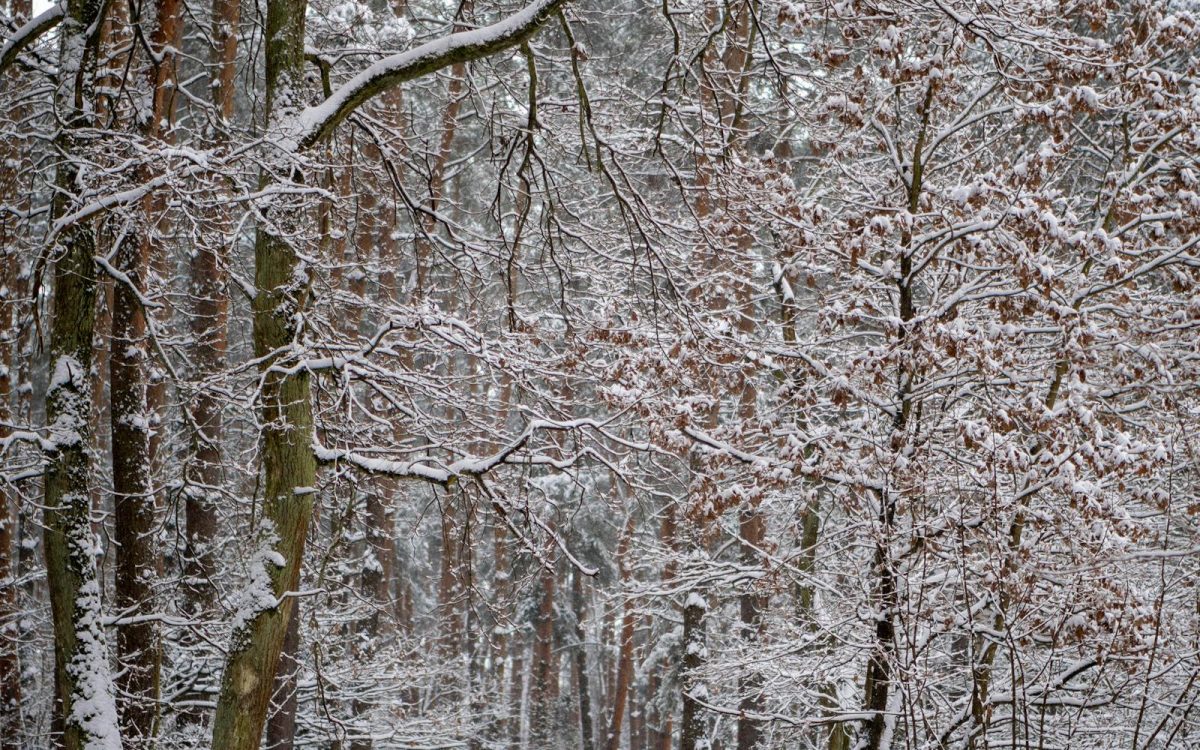
Bare trees are their own kind of study. Without leaves, the branching architecture of different species becomes clearly visible. Oak spreads into an irregular tangle of sturdy arms. Ash forms elegant, arching shapes with distinctive black buds at the tip of each twig. Beech holds its old leaves, brown and papery, long into winter, rustling in a way that is instantly distinctive once you have heard it. Following nature through every season builds the kind of familiarity with trees that makes each one feel like a known neighbour.
Finding Winter Nature in Unlikely Places
You do not need wilderness to find winter nature. A winter walk through a cemetery, an overgrown railway margin, or a scrubby urban park can yield as much as a country walk, sometimes more. Urban heat islands mean city centres stay marginally warmer, and some species exploit this. Peregrines hunt pigeons from tall buildings in dozens of cities. Foxes are more confident and easier to observe in urban areas than in the countryside. Starling murmurations happen over city centres as thousands of birds gather from surrounding farmland to roost under bridges or in dense shrubs.
If you have a patch of outdoor space, however small, there are simple things that help winter wildlife and reward your watching. A shallow dish of fresh water, checked daily and kept free of ice, draws birds for drinking and bathing even in hard frost. A brush pile or rough corner left unmown gives hibernating insects and small mammals a refuge. These actions are not charity; they are an invitation to be part of a local web of life that existed long before the buildings around it.
Dressing for Winter Watching
Cold discomfort is the main reason people stay inside when they could be outside, and it is almost entirely preventable. The difference between a miserable winter walk and a wonderful one often comes down to two things: foot warmth and the ability to stand still. Waterproof, insulated footwear and thin gloves that still allow dexterity cover most situations. A thermos of something hot transforms a cold hour of watching at a lake edge from an endurance test into a pleasure.
Standing still is the hardest part of winter wildlife-watching, and it is also the most rewarding. Animals that would flush at movement will sometimes behave almost as if you are not there if you stay completely still for ten minutes or more. Picking a spot with your back to a tree, a wall, or any solid background breaks up your outline and makes you less conspicuous. The reward for that stillness might be a sparrowhawk landing three metres away, or a pair of foxes moving through a field in the low winter light, unaware of your presence.
The Particular Gift of Winter Light
Winter light travels at an angle that summer never reaches. From November through February in temperate latitudes, the sun stays low for its entire arc, casting long shadows even at midday and turning ordinary fields and woods into something painterly in early morning and late afternoon. The golden hour in winter lasts considerably longer than its summer equivalent, which gives you a more generous window for being outside in beautiful conditions.
Clear winter nights offer their own reward. Away from city lights, the lack of summer haze and the long hours of darkness make winter one of the best seasons for stargazing. Orion climbs high in the south, the Pleiades cluster is well-placed, and the Milky Way arcs overhead on moonless nights. For anyone wanting to explore this side of the season, backyard stargazing is an easy and inexpensive way to start.
Winter asks you to slow down, dress well, and bring a willingness to find beauty in bare and quiet things. In return, it gives you an intimacy with the natural world that the busier seasons make harder to access. Go out on the coldest clear morning you can manage, stand at the edge of something wild, and let the season show you what it has.