Anúncios
My first nature journal was a free notepad from a conference, the cover already creased, the pages slightly yellow. I took it to a local pond one October morning because someone had mentioned journaling and I thought, why not try. I sat on a damp log, watched a heron stand motionless in the shallows for twelve minutes, and wrote two paragraphs. By the time I stood up, I had noticed three things about that pond I had passed dozens of times without really seeing. That scrappy notepad became the first of many.
What Nature Journaling Actually Is
Nature journaling is the practice of recording direct observations of the natural world in a personal notebook. It is not the same as writing a scientific field report, and it is not a social-media-ready sketchbook. It sits somewhere between a diary and a field guide written only for you. You can include words, rough drawings, measurements, questions, or simply how something made you feel. There is no single correct format, which is both the challenge and the freedom of it.
Anúncios
The practice has a long history. Gilbert White kept meticulous records of the seasons in his Hampshire village in the 1700s. Charles Darwin filled dozens of notebooks on his voyages. But you do not need their ambition or their expertise. The point is paying closer attention to the patch of world in front of you, and writing it down so you remember.
Choosing Your Materials
Start simple. A small notebook that fits in your pocket or bag, a pencil or a pen that does not bleed in light rain, and a willingness to get the pages a little grubby. That is genuinely all you need for nature journaling as a beginner.
Anúncios
If you find yourself journaling regularly after a month or two, you might consider a notebook with thicker, unlined pages that can handle a wash of watercolor or a pencil rubbing without warping. But spending money on gear before you have established the habit is a classic way to add pressure to something that should feel low-stakes.
Finding Your Spot
The best location for your first few journal sessions is whatever outdoor space is already part of your routine. A garden bench, a patch of grass at a local park, the edge of a trail you walk regularly. Returning to the same spot over weeks and months is one of the most rewarding aspects of nature journaling, because you start to notice change. The oak that looked bare in February will have small leaves by April. The muddy patch by the gate will hold animal tracks after rain.
Variety is good later on. To begin, familiarity builds confidence. When you know a place a little, you have a baseline to compare against, and comparisons are where the most interesting observations live.
What to Write in Your First Entry
Before you put pen to paper, spend two or three minutes just sitting and looking. This brief pause is the most useful thing you can do. Let your eyes rest on one thing at a time rather than scanning around. Notice texture, color, movement, stillness.
Then write the date, the time, the weather, and the location. These four pieces of information transform a stray observation into data you can look back on. After that, describe one specific thing. Not “there were birds” but “a small brown bird with a rusty chest pulled a worm from the mud near the path, then flew straight up into the hedge.” Specificity is the whole game. You do not need to know the bird’s name to write something useful. If you want to identify it later, a description like that will help you do so, and beginner birdwatching guides can be a useful companion to your journal.
Including Sketches Without Stress
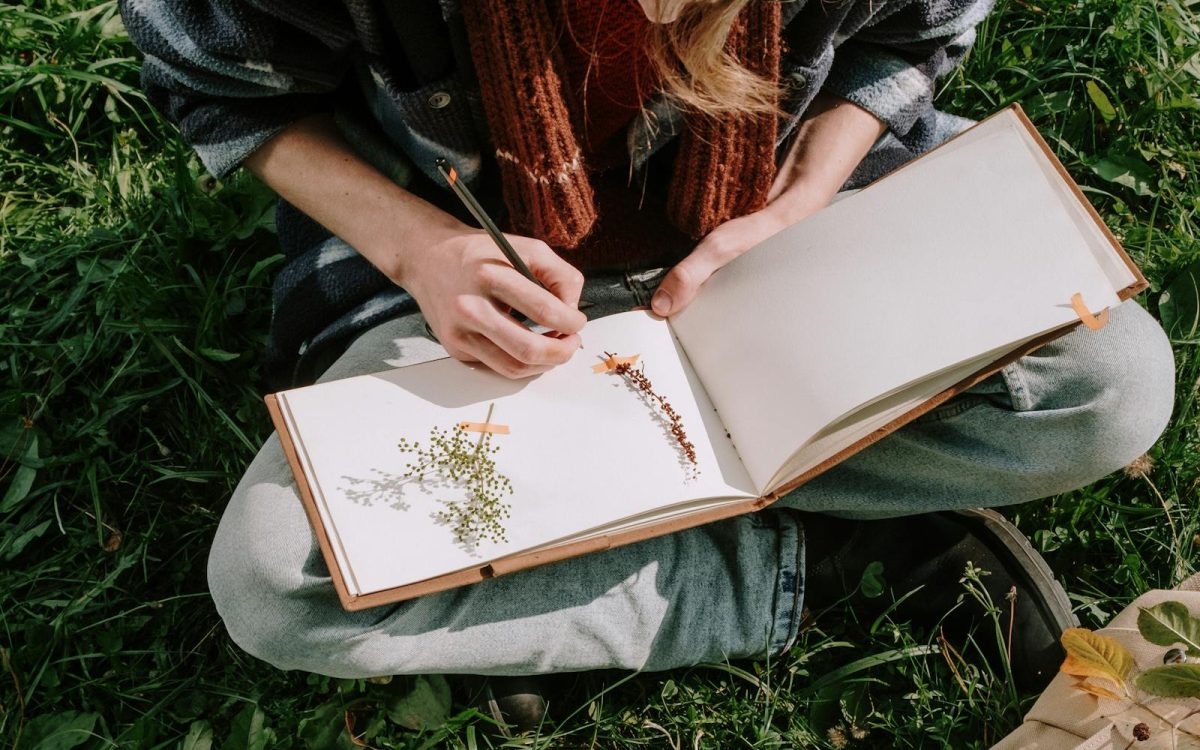
Many people avoid journaling because they believe they cannot draw. The belief is mostly irrelevant to the practice. A sketch in a nature journal serves as a memory aid and a focusing device, not a piece of art. When you try to draw a leaf, you notice things about it you would never notice otherwise: the angle of the veins, the slight curl at the tip, the tiny serrations along the edge.
Try this: draw the outline of a leaf or a small stone in thirty seconds. It does not matter whether it looks accurate. The act of trying forces your eyes to gather information they usually skip. A rough sketch plus a sentence of description is more informative than either alone.
Building the Habit
One of the quieter rewards of nature journaling is the cumulative record it builds. After a full year of even occasional entries, you have something no app or photograph can quite replicate: a log of your own growing attention. You will see how your observations became more specific over time, how your vocabulary for the natural world expanded, and how the same spot changed through every season.
Keep the sessions short at first. Ten minutes three times a week is more sustainable than an hour once a month. Write even when you feel you have nothing to say, because the act of looking for something to write about is itself the practice. On days when a place feels empty, try describing the light, the smell of the air, or the sounds in layers from nearest to furthest away.
A mindful approach to outdoor time pairs naturally with journaling, and many people find the two reinforce each other. The journal gives your mindful time a shape, and the mindful attention gives your journal something worth recording.
Common Pitfalls to Avoid
The biggest risk to a new nature journal is perfectionism. If you wait for a clear day, the right notebook, enough free time, and something impressive to see, you will rarely open it. Imperfect entries made regularly beat perfect entries made never.
Resist the urge to use your journal as a tick-list of species identified. That kind of recording has its own value, but it can push you toward skimming over what you see rather than sitting with it. A single observation explored in detail is worth more than a list of twenty species you barely glanced at.
Do not photograph first and look second. The photograph habit, useful as it is, can work against the close attention that journaling builds. Try looking for a full minute before reaching for your phone. If you then want a photograph too, take it, but let the looking come first.
If you are curious about extending your nature practice beyond the journal, activities like slow, mindful birdwatching and introductory nature photography build on exactly the same observational skills you are developing here.
Your First Week
Go outside with your notebook three times this week. Each time, sit for at least five minutes before writing. Date every entry. Describe one thing in as much detail as you can manage. Sketch something once, even roughly. At the end of the week, read back what you wrote and notice what surprised you.
That is the whole starter plan. The rest builds itself, one observation at a time, across seasons you will actually remember.