Anúncios
Crouch beside a patch of open flowers on a warm afternoon and give yourself five minutes to watch without rushing off. You will almost certainly see bees, but look past them. That narrow-waisted insect hovering almost perfectly still, striped in yellow and black, is not a bee. That dull grey moth feeding in broad daylight is not looking for a porch light. That iridescent beetle resting inside a poppy is eating, and accidentally picking up pollen in the process. Your garden is running a full pollinator service and most of the workers never get named.
What Pollination Actually Requires
Pollination happens when pollen from the male part of one flower is transferred to the female part of another of the same species. Any creature that visits flowers regularly and carries pollen on its body counts as a pollinator, even if pollination is an accidental side effect of feeding. Bees are efficient pollinators partly because they are covered in branched, pollen-trapping hairs and visit flowers deliberately to collect pollen as food. But plenty of other insects pick up and deposit pollen as they go about their lives, and for some plant species, those other insects are the primary or even the only pollinator.
Anúncios
This matters practically because a garden or yard that hosts only bees is more fragile than one hosting a full range of pollinating species. Different pollinators are active at different times of year, different times of day, and in different weather conditions. A diverse pollinator community provides a kind of insurance.
Hoverflies: The Underrated Pollinators
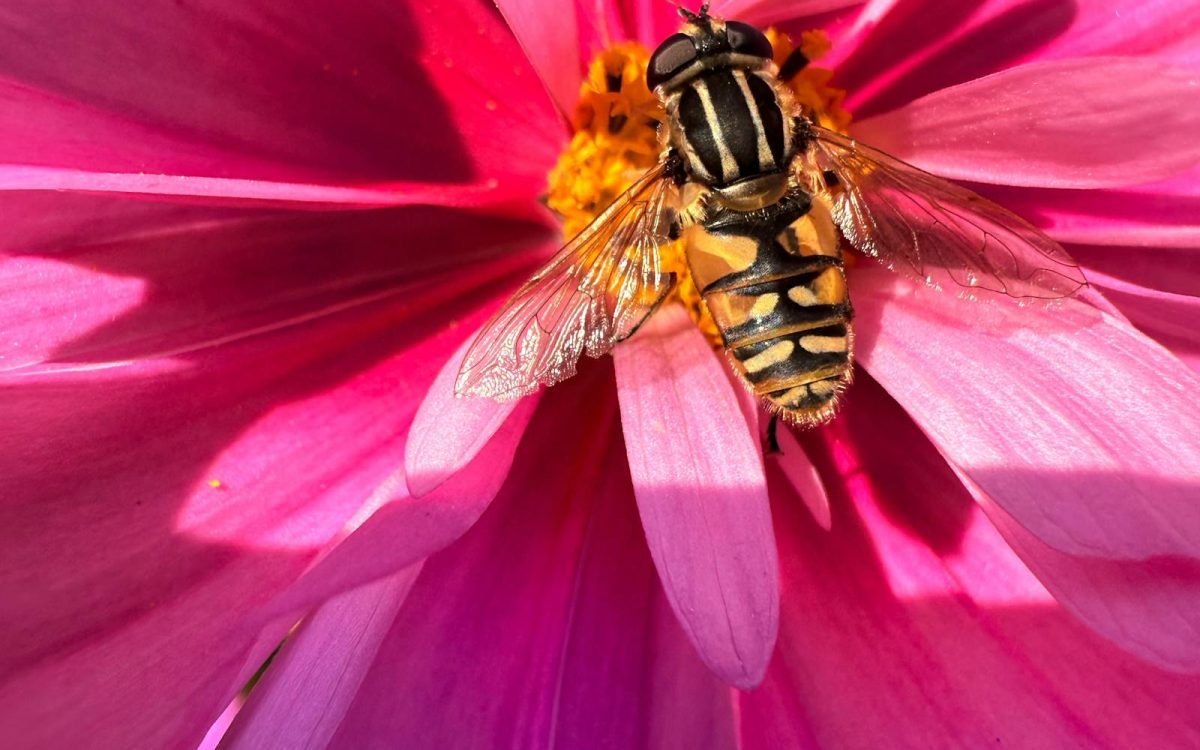
If you have ever mistaken a small yellow-and-black striped insect for a bee and then noticed it hovering motionlessly in midair, you were almost certainly looking at a hoverfly. This mimicry is deliberate on the hoverfly’s part: resembling a stinging insect deters predators. But hoverflies do not sting and are completely harmless.
Anúncios
In Britain alone there are around 280 hoverfly species. In North America there are hundreds more. Many are strikingly beautiful at close range, with banded abdomens in yellow, orange, and white. They visit a wide range of flowers and are particularly drawn to flat-headed flowers like yarrow, wild carrot, and feverfew that give them an easy landing platform and accessible nectar. Some species, like the drone fly, mimic bumblebees closely enough to fool a casual observer.
Hoverflies are particularly valuable in early spring and late autumn when bee populations are lower, and they are often more cold-tolerant than bees. Their larvae have varied lifestyles; some eat aphids (making adult hoverflies doubly useful), while others live in decaying wood or wet soil.
To attract more hoverflies, include umbellifers in your planting, plants with flat flower heads in the carrot family such as fennel, cow parsley allowed to self-seed at the border edge, angelica, and sweet cicely. These are among the most consistently visited flowers in any garden survey.
Moths and Butterflies: Daytime and Nighttime Pollinators
Butterflies are familiar garden visitors, and most people know they pollinate flowers. What is less widely appreciated is that moths, despite their nocturnal reputation, are significant pollinators of a surprising range of plants. Some moth species are active in daytime; the hummingbird hawk-moth, which hovers at flowers in the manner its name suggests, is a daytime visitor that genuinely thrills people who see it for the first time.
Nighttime-flying moths are responsible for pollinating plants that open or intensify their scent after dark. Evening primrose, honeysuckle, white-flowered tobacco plant, sweet William, and night-scented stock have all evolved to attract moths, producing pale or white flowers visible in low light and releasing their strongest fragrance at dusk. A garden that includes some of these plants brings in a whole community of pollinators that daytime gardeners rarely see.
Both butterflies and moths also act as pollinators incidentally when feeding on nectar from a wide range of other flowers. Their long proboscis allows them to access nectar in tubular flowers that bees with shorter tongues cannot reach, making them the primary pollinator for some deep-tubed species. Attracting butterflies to your garden typically also draws in moths, since many of their favoured nectar sources overlap.
Wasps, Beetles, and the Overlooked Pollinators
Wasps get almost universally negative press, which is unfortunate because they perform real pollination work. Like hoverflies, many wasp species visit flowers for nectar and transfer pollen on their smooth abdomens as they do. They are drawn particularly to flat-headed flowers, and in late summer when bee numbers fall, their contribution to garden pollination increases. Some specialist plants, figs being the most famous example, depend on particular wasp species for pollination entirely.
Beetles were pollinating plants before bees existed. Large, open, bowl-shaped flowers like poppies, wild roses, and magnolias are essentially evolved for beetle visitors, offering accessible pollen and space for beetles to move around and feed. Beetles are not precise pollinators; they wander through flowers eating and leave pollen behind somewhat randomly. But for certain plant families, this rough-and-ready system works perfectly.
Flies other than hoverflies, including some blowflies and greenbottle species, pollinate flowers with accessible pollen and nectar. Some plants in the orchid family even deceive flies by mimicking the scent or appearance of rotting organic matter, trapping flies temporarily and loading them with pollen before releasing them to carry it elsewhere.
What Backyard Pollinators Beyond Bees Need From Your Garden
The requirements of non-bee pollinators overlap significantly with those of bees but differ in some specific ways. Hoverflies need aphid colonies for some of their larvae, which means not eliminating every aphid from the garden has a benefit. Moth caterpillars need specific larval food plants, many of which are native wildflowers or common hedgerow plants. Beetles need dead wood, fallen logs, and leaf litter for egg-laying and larval development.
Planting a diverse range of native flowering species is the common thread. Native plants have co-evolved with local pollinators over thousands of years, and many relationships between specific plants and specific insects are more specialised than they appear. A garden that includes some native scrub, some undisturbed leaf litter, some dead wood, and a range of flower shapes and heights provides the structural variety that supports the full community.
The timing of your garden maintenance matters as well. Cutting back stems and tidying borders in autumn removes overwintering sites for many of these species. Leaving stems standing and leaf litter in place until spring, as recommended for bee conservation, benefits the full range of pollinators. Starting a pollinator garden with this broader community in mind from the beginning gives you a more resilient and ecologically rich result than designing exclusively for bees.
Helping Children and Newcomers See These Visitors
One of the pleasures of learning to identify the non-bee pollinators is that it transforms a flower bed from a decorative backdrop into a constantly changing cast of characters. A hand lens or a phone camera with a decent close-up mode is enough to see hoverfly eyes, the intricate wing venation of a moth, or the metallic sheen on a green fly’s abdomen. These are genuinely extraordinary things to see for the first time.
Sitting near a patch of open flowers with the specific intention of watching who arrives, and trying to name what you see, is one of the most accessible forms of wildlife observation available. You do not need to go anywhere. Observing nature in your own yard in this focused way builds identification skills quickly because you encounter the same species repeatedly in a familiar setting.
Apps like iNaturalist and Seek let you photograph insects and get identification help from a global community of naturalists. Hoverfly identification in particular has been made significantly easier by dedicated online resources and field guides that were not available a decade ago.
A More Complete Picture
Bees will always be the headline act of pollination, and they deserve the attention they receive. But a yard managed only for bees misses half the story. The hoverfly hovering above your fennel, the hawk-moth feeding from your honeysuckle at ten at night, the beetle inside your poppy in the morning: all of them are part of the same essential work, and all of them are worth knowing. A garden that welcomes the full cast is not only doing more ecological good; it is also a more interesting place to spend time.