Anúncios
A moth lands on a lichen-covered tree trunk and vanishes. Not because it moved, but because the pattern on its wings matches the bark so precisely that a searching bird’s eye slides right past it. That match did not happen by chance. It is the accumulated result of generations of moths with slightly better bark-matching patterns surviving to reproduce, while those that stood out were eaten before they could pass on their genes. The moth carries its history on its wings.
What an Adaptation Really Is
An adaptation is any inherited characteristic, physical or behavioural, that improves an animal’s chances of surviving and reproducing in a particular environment. The word covers an enormous range of things: the shape of a beak, the timing of a migration, the thickness of a winter coat, the ability to store fat, the pattern of stripes on a skin. What they share is that they were shaped by natural selection over generations.
Anúncios
Natural selection is the mechanism. Individuals within any population vary slightly from one another. Some variants prove more useful in the current environment. Those individuals survive and reproduce more successfully. Their offspring inherit the useful variant. Over time, that variant becomes more common across the population. Given enough time and enough generations, small accumulated differences produce the extraordinary diversity of animal life we see today.
It is worth being precise here: an adaptation is not something an animal chooses or works toward. A giraffe did not stretch its neck during its lifetime and pass on a longer neck to its offspring. Giraffes with slightly longer necks in their ancestral population had better access to food, survived better, and left more descendants. Over many thousands of generations, neck length in the population shifted upward.
Anúncios
Camouflage: Becoming the Background
Camouflage is one of the most visually striking adaptations and also one of the most widespread. It appears in nearly every animal group, on every continent, in every type of habitat. The core principle is simple: an animal that matches its background is harder for predators to spot, and harder for prey to detect if it is the predator doing the hunting.
The detail that evolution has produced in camouflage patterns is astonishing. Leaf-tailed geckos in Madagascar have bodies shaped like dead leaves, complete with vein-like markings and ragged edges mimicking decay. Stonefish look exactly like encrusted rocks on the seafloor, a disguise so good that people have stepped on them and suffered the consequences of hidden venomous spines. The Arctic tern has a crisp white and grey plumage that breaks up its outline against sky and sea from below, where the fish it hunts might otherwise see it coming.
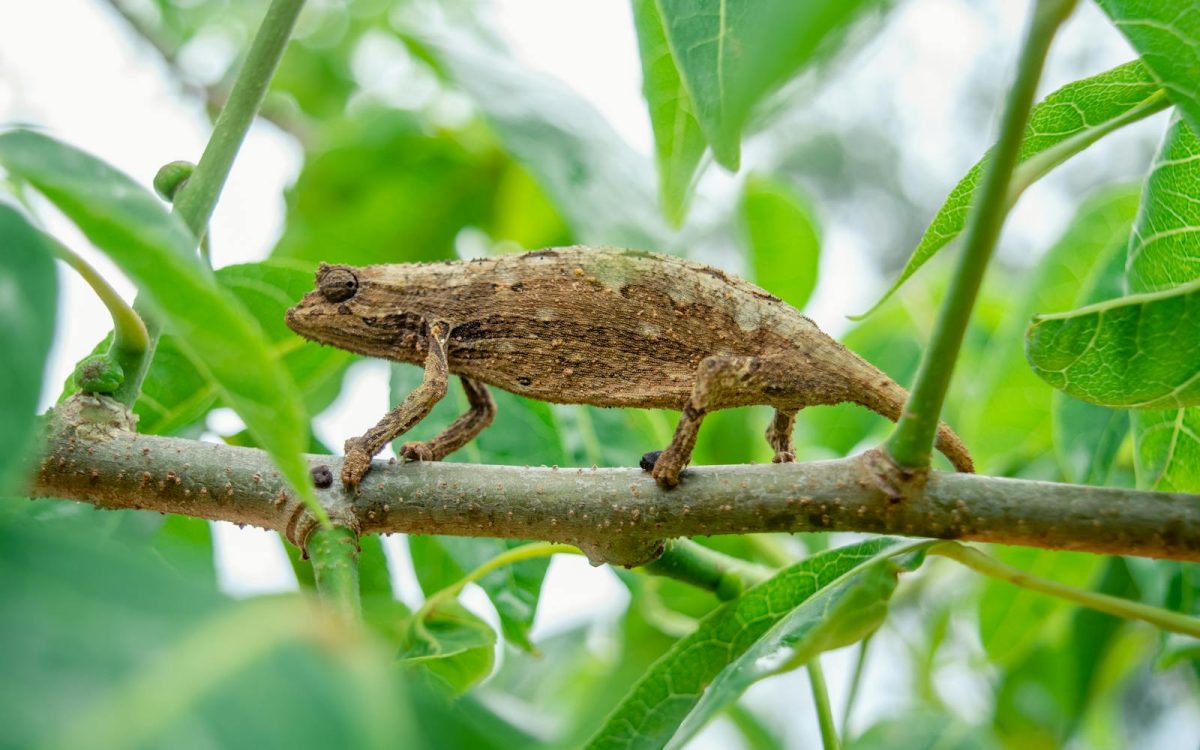
Some animals take camouflage further by changing their appearance actively. The common cuttlefish can alter both the colour and the texture of its skin in milliseconds, matching different backgrounds as it moves across the seafloor. Chameleons are famous for colour-changing, though their colour shifts are primarily for communication and temperature regulation, with camouflage as a secondary benefit. The flounder, a flatfish, can match a sandy, gravelly, or patterned seafloor within seconds of settling onto it.
Hibernation and Torpor: Sleeping Through Scarcity
Some problems cannot be solved by being faster or better hidden. A North American woodland in January has almost no insects, scarce plant food, and temperatures that make staying active expensive in terms of caloric burn. The solution many animals have evolved is to simply stop.
True hibernation, as seen in ground squirrels, hedgehogs, and some bats, is a profound physiological state. Body temperature drops to within a degree or two of the surrounding air. Heart rate can fall from a resting 300 beats per minute to fewer than 10. Breathing slows to just a few breaths per minute. The animal lives on stored body fat for months without eating, drinking, or producing significant waste. Waking up is itself an energy-expensive process: the body must generate enough heat to return to operating temperature before the animal can move effectively.
Bears are often called hibernators but technically enter a lighter state called torpor. Their body temperature drops only slightly, they can be roused, and female bears give birth and nurse cubs during this period. That distinction matters: a truly hibernating ground squirrel would not be able to nurse newborns. Bears’ winter dormancy is still an impressive physiological feat, but it operates on a different scale.
Some animals show short-term torpor as a nightly strategy rather than a seasonal one. Hummingbirds, with their extraordinarily fast metabolisms, cannot maintain body temperature through cold nights on available food alone. Many species drop into nightly torpor, cooling by up to 20 degrees Celsius and slowing their heart rate dramatically, then warm up again at dawn. Without this ability, many hummingbird species could not survive in the mountain environments where they live.
Migration: Moving the Problem
Where hibernation says “wait out the bad season,” migration says “leave it entirely.” Arctic terns hold the record for sheer distance, travelling from breeding grounds near the North Pole to Antarctic waters and back, a round trip of some 70,000 kilometres each year. They follow the path of summer itself, arriving at each destination when food is most abundant.
Migration requires its own suite of adaptations. Many migratory birds navigate using a combination of star patterns, the Earth’s magnetic field, the position of the sun, and landmarks memorised from previous journeys. Monarch butterflies navigate thousands of kilometres to specific overwintering forests in Mexico, despite no individual butterfly having made the journey before, since the overwintering generation lives long enough to complete the full trip but not the return.
The physiological preparation for migration is also an adaptation. Many migratory birds undergo a period of hyperphagia before departure, doubling or trebling their body weight in fat deposits to fuel the journey. Geese, ducks, and warblers all do this. Some small songbirds fly nonstop across open water for days, burning fat reserves at a rate that would be lethal over a longer period if they could not land and refuel.
For a fuller look at the mechanics and triggers of these journeys, the piece on why animals migrate covers the full range of migratory strategies in detail.
Physical Adaptations: Teeth, Skin, and Structure
Beyond camouflage, physical adaptations shape every aspect of an animal’s body to match the demands of its life. The thick, layered fat of a walrus keeps it warm in Arctic waters. The hollow, air-filled bones of birds reduce weight for flight while remaining structurally strong. The grooved incisors of a beaver grow continuously to compensate for the wear of gnawing wood, and they are orange because the enamel contains iron compounds that harden the cutting edge.
The bill shapes of birds offer a compressed lesson in adaptation. The crossbill has a beak with tips that literally cross, a design for levering open conifer cones. The spoonbill sweeps its flat, spatula-shaped bill through water to filter small creatures. The woodpecker’s bill is straight, strong, and shock-absorbing at the base, built to drive into bark repeatedly without causing brain injury. Each form is a precise fit for a specific food source in a specific habitat.
Countershading is a physical adaptation so widespread it is easy to overlook. Most birds, fish, and mammals are darker on top and paler below. From above, the dark back blends with the ground or deeper water. From below, the pale belly blends with the sky or surface light. Sharks, penguins, and robins all use this same principle, despite having almost nothing else in common.
Behavioural Adaptations: Inherited Instincts
Not all adaptations are built into the body. Some are built into behaviour. The nest-building instincts of weaver birds, the elaborate courtship dances of birds-of-paradise, the specific warning calls ground squirrels use that distinguish aerial from terrestrial predators, all of these are behavioural adaptations, inherited tendencies shaped by natural selection just as physical features are.
Thanatosis, or playing dead, is a behavioural adaptation seen in opossums, some snakes, and certain beetles. Many predators avoid carrion they did not kill, so convincing a predator you are already dead can be a genuine escape strategy. The Virginia opossum’s response is involuntary: when overwhelmed, the animal goes limp, its lips pull back, saliva foams, and its body releases a scent from its anal glands that mimics decomposition. This is not a conscious choice. It is a hardwired stress response that evolution has rewarded.
Understanding how these behavioural and physical tools connect to the animal’s diet and ecological role becomes clearer when you read about how dietary categories shape animal bodies from the ground up.
Adaptation Is Always in Progress
Adaptation is not something that happened in the past and finished. Natural selection is operating right now, in every wild population, on every generation. Urban foxes in London have measurably shorter snouts and smaller brains than their rural counterparts, changes that have occurred over fewer than a hundred years of urban living. House sparrows in North America, introduced in the 1800s, have developed measurably different body proportions across different climate zones in just a few dozen generations.
Climate change is pushing adaptation into focus in new ways. Populations that can respond fast enough to shifting conditions by adjusting the timing of breeding, migration, or hibernation are persisting. Those whose inherited timing is too rigid to match a changing environment are declining. The wild world is full of these ongoing experiments, most invisible to casual observation but measurable over time in ways that tell us which solutions are still working and which ones nature may soon need to revise.