Anúncios
The first time I watched a wood frog pond in early spring, I understood something about life cycles that no textbook had fully conveyed. In March, with ice still at the edges, hundreds of frogs converged on a small woodland pool that had been frozen and apparently empty two weeks before. They mated, laid their eggs in communal masses, and most of them vanished back into the leaf litter within days. By June, the pond was thick with tadpoles. By August, thumbnail-sized froglets were hopping into the forest for the first time. By the following March, some would return to the same pond to begin again. That compact, seasonal loop is what an animal life cycle looks like in practice: a precise sequence of stages shaped by millions of years of pressure to survive long enough to reproduce.
The Basic Framework: Stages Every Animal Shares
Every animal life cycle passes through the same fundamental sequence, even if the details vary wildly. Birth or hatching, growth and development, sexual maturity, reproduction, and eventually death. Around this skeleton, evolution has built an almost infinite variety of specific strategies: different timings, different forms at different stages, different amounts of parental investment, and different relationships between the stages.
Anúncios
The version most people learn first is the simplest: an animal is born, grows, reproduces, and dies, looking more or less the same throughout. Direct development, as biologists call it, is the pattern of lizards, birds, and most mammals. A baby lizard is a scaled-down adult. A foal is clearly a small horse. The journey from birth to reproductive maturity is one of growth and refinement, not structural transformation.
But a large part of the animal kingdom follows a very different script.
Anúncios
Complete Metamorphosis: The Four-Stage Revolution
Butterflies and moths, beetles, flies, bees, wasps, and ants all undergo complete metamorphosis, known scientifically as holometabolism. The four stages are egg, larva, pupa, and adult, and the transformation between larva and adult is one of the most radical changes any living organism undergoes.
Inside the chrysalis of a butterfly, the caterpillar does not simply rearrange itself. In many species, it partially dissolves into a cellular soup before rebuilding into the adult form. The caterpillar and the butterfly are the same individual, yet they look, eat, and behave so differently that naturalists once believed they were separate species. A monarch caterpillar eats milkweed leaves. The adult drinks nectar. They live in entirely different parts of the plant, use different sensory systems, and move through the world in opposite ways: one crawling, one flying.
This splitting of the life cycle into distinct ecological roles is a significant advantage. The larva specializes in eating and growing. The adult specializes in dispersing, finding mates, and reproducing. Because they do not compete with each other for resources, the species as a whole can exploit more of the available food supply.
Incomplete Metamorphosis: The Gradual Change
Grasshoppers, dragonflies, crickets, and true bugs follow a different path called incomplete metamorphosis or hemimetabolism. After hatching from eggs, the young emerge as nymphs: miniature versions of the adult that lack functioning wings and reproductive organs. With each molt, shedding their exoskeleton to grow, the nymph looks progressively more like an adult, until the final molt reveals a fully formed, sexually mature individual.
Dragonfly nymphs are a particularly striking example. They live underwater for anywhere from one to five years, breathing through gills, hunting aquatic prey, and bearing almost no visual resemblance to the jewel-colored adults that will eventually emerge. When the nymph is ready, it climbs out of the water on a reed stem, its exoskeleton splits, and an adult dragonfly pulls itself into the air for the first time. One animal, two completely different lives: one aquatic and one aerial, separated by a single molt.
Amphibian Life Cycles: The Textbook Example
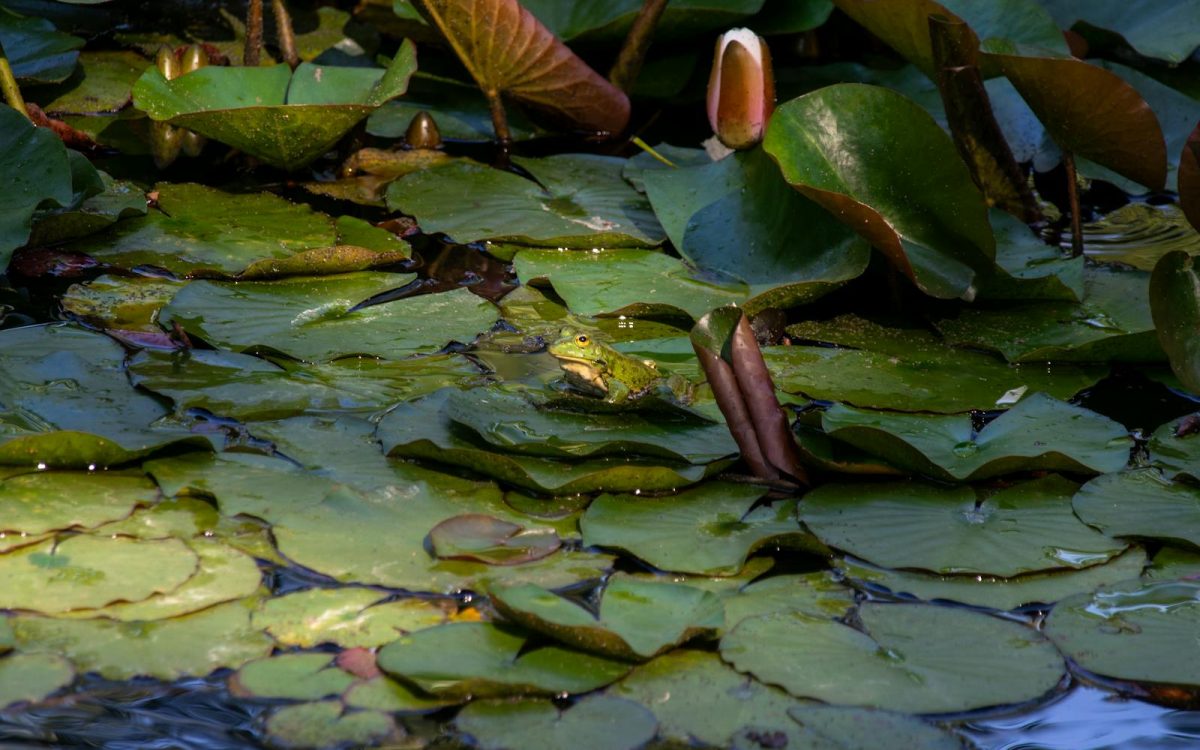
Frogs and salamanders have some of the best-studied life cycles among vertebrates, and they illustrate the core principles clearly. Most frogs begin as eggs laid in water, hatch into aquatic tadpoles with tails and gills, gradually develop lungs and legs while their tails are reabsorbed, and emerge from the water as terrestrial froglets. The whole process, from egg to air-breathing juvenile, can take anywhere from a few weeks in tropical species to two years in cold-climate ones.
What makes amphibian life cycles particularly interesting is how sensitive they are to environmental conditions. Temperature, rainfall, and water quality all influence how quickly the stages progress and how many individuals survive each transition. This sensitivity is part of why amphibians are considered indicator species: their populations reflect the health of both aquatic and terrestrial environments at the same time. A pond where tadpole survival is plummeting is telling you something important about water quality, ecosystem health, or both.
Mammal Life Cycles: Heavy Investment, Slower Pace
Mammals took a different evolutionary path. Instead of producing thousands of offspring and accepting high mortality, most mammals produce few offspring and invest heavily in each one. The gestation period, the time the young spend developing inside the mother, ranges from about three weeks in mice to nearly two years in elephants. After birth, extended parental care, provided by nursing, protection, and teaching, extends the investment further.
The payoff is high survival rates per offspring and, in many social species, the transmission of learned behavior from one generation to the next. A young wolf does not just survive on instinct; it spends months learning how to hunt by watching and participating alongside experienced pack members. A young chimpanzee may spend years learning tool use and social navigation from its mother and community. This cultural transmission is a form of inheritance that operates alongside genetic inheritance and can shift behavior over just a few generations.
Marsupials, like kangaroos and wombats, offer a fascinating middle ground. Their young are born at an extremely early stage of development, then continue growing in an external pouch where they are protected and nursed. A newborn kangaroo is about the size of a lima bean and largely undeveloped. It reaches the pouch by instinct and climbs in immediately after birth. It will spend months there before being ready to emerge, and may continue returning to the pouch for warmth and nursing for months after that.
Life Cycles and Seasonal Timing
For most animals, the timing of life cycle stages is not arbitrary. It is tightly synchronized with seasonal conditions to maximize the chances that vulnerable young will face the easiest possible conditions for survival.
Many bird species time their egg-laying so that chicks hatch at peak caterpillar emergence, the single richest food source available. If the timing slips, either because the birds nest too early or because warming temperatures push caterpillar peaks earlier than the birds’ internal clocks expect, chick survival rates drop sharply. This mismatch between the timing of different components of a food web is called phenological mismatch, and it is one of the documented consequences of climate change that affects wildlife from insects to seabirds.
Salmon life cycles are another example of seasonal precision. Pacific salmon hatch in freshwater rivers, migrate to the ocean, spend two to five years feeding and growing, and then, guided by the specific chemical signature of the stream where they were born, return to reproduce and die. Their decaying bodies deliver marine nutrients deep into forested watersheds, feeding trees, bears, eagles, and the insects that feed the next generation of fish. The cycle connects the ocean to the interior of a continent in a single organism’s lifespan.
Why Life Cycles Matter for Conservation
Understanding an animal’s life cycle is not just biology trivia. It is essential information for anyone trying to protect a species. A species that reproduces only once a year, produces a small clutch, and requires specific habitat conditions at each life stage is far more vulnerable to disturbance than one that breeds opportunistically and has young at several stages at any given time.
Sea turtles, for instance, require undisturbed beaches for egg-laying, cool sand temperature ratios that produce viable hatchlings, and clear coastal water for the juveniles to navigate. Disrupt any one stage and the entire reproductive effort of a season is lost. For a species that may not reach sexual maturity for 20 to 30 years, losing even one or two breeding seasons per decade is serious. This is why conservation programs for slow-reproducing species focus so carefully on protecting the specific conditions needed at each stage of the life cycle, not just the adult animals.
The diversity of life cycles across the animal kingdom is, in its own way, a record of the different challenges different environments have posed over evolutionary time. Each strategy, from the brief flame of a mayfly’s adult life to the century-spanning arc of a Greenland shark, is an answer to the same question: how do you get the next generation started? The answers, it turns out, are more varied and more ingenious than you might expect. For a broader look at how these strategies fit into the larger picture of animal diversity, explore our guide to how animals adapt to survive across all the habitats they occupy.