Anúncios
There is a blackbird in my neighbour’s apple tree who has spent the last three mornings cracking snails on the same flat stone. I know this because I sat still long enough to watch him do it twice, then came back early the next day to see whether he would return. He did. That small discovery, made in a suburban garden with nothing but a cup of tea and a patch of patience, is precisely what slow birding offers.
Why Slow Birding Exists
Birdwatching has a competitive streak. Lists, year counts, life lists, and the social media pressure to share every good sighting can subtly transform a meditative practice into something goal-driven. Slow birding is a conscious response to that tendency, a way of returning to the original pleasure of simply watching a living creature go about its life.
Anúncios
The concept was described and named largely by American naturalist Pete Dunne, whose writing on the subject struck a chord with many birders who had found themselves rushing past common species to tick off rarities. His central idea is straightforward: the most ordinary bird, given your full attention, becomes extraordinary. A starling on a lawn is not a consolation prize for failing to find a rare warbler. It is a bird with a complex social life, a remarkable vocal range, and a set of behaviours that reward careful study.
The Practical Difference Between Fast and Slow
A fast birding walk through a park might cover two miles and accumulate 25 species on a list. A slow birding session in the same park might cover 200 metres and spend 40 minutes with a single song thrush. Neither approach is wrong. But the slow version leaves you with something different: a memory of how the thrush paused between feeding bouts to scan in a full circle, how its bill left a specific oval depression in the mud at the same spot repeatedly, how it reacted to the shadow of a passing pigeon overhead with an immediate crouch and freeze.
Anúncios
That kind of knowledge cannot be gathered quickly. It accumulates through time and stillness, and once you have it about one species, you will want it about others. Slow birding, paradoxically, tends to make people better naturalists overall, because the habit of close attention transfers to everything else they observe outdoors.
How to Set Up a Slow Birding Session
Choose a location you can reach easily and return to repeatedly. Your garden, a local park, a canal towpath, or a churchyard all work well. Consistency of location matters more than drama of scenery. Familiar ground means that changes, a new arrival, a territory shift, an unusual behaviour, stand out clearly against the baseline you have built.
Sit down if you can. Standing observers are more visually intrusive, and birds habituate faster to a person who stays in one place than to one who moves. Even perching on a low wall or a park bench becomes less threatening to local birds after ten minutes of stillness. Wear colours that do not contrast sharply with the environment; you do not need specialist camouflage, but a bright white jacket makes you more noticeable than a muted grey or green.
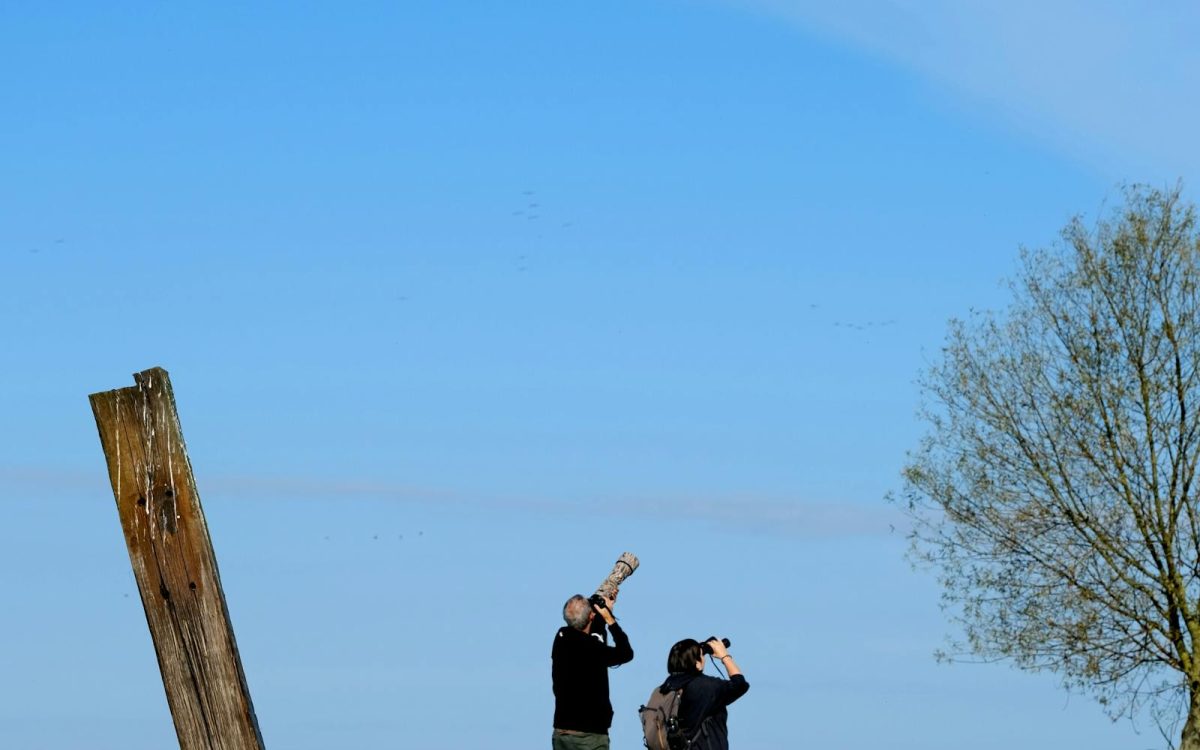
Give yourself a minimum of 30 minutes and no fixed goal. You are not trying to see anything in particular. You are simply present and observant. This is the same quality of attention that forest bathing cultivates, except that here you have feathered subjects to focus on.
What to Watch For Once You Are Still
Behaviour is far more interesting than mere identification, and it only becomes visible once you have been patient enough to stop being a disturbance. Watch how a bird moves: does it hop with both feet together, or does it walk alternating feet? Robins hop; crows walk. Does it probe, peck, or glean? Where does it look after a sound startles it?
Watch interactions. Two birds of the same species near a feeder are rarely neutral toward each other. There is usually a hierarchy expressed through subtle postural signals, a raised wing, a tilted head, a brief chase. Watch what the bird ignores as much as what it reacts to; knowing a bird’s threat threshold tells you a great deal about its personality and its history with human presence in this spot.
Song is worth specific attention. The blackbird’s alarm call is a sharp, rattling chink used when it spots a cat. Its territorial song is a rich, unhurried fluting that sounds almost improvised. Many birds have five or more distinct vocalisations, and once you start connecting sounds to contexts, the noise outside your window in the morning becomes a legible conversation.
Slow Birding Across the Seasons
One of the quiet rewards of returning to the same patch consistently is that the seasons reveal themselves in fine detail. In late winter, watch for the moment when a male robin begins to sing from a higher perch, claiming territory for the year ahead. In spring, the chaos and colour of nesting activity unfolds at eye level in hedgerows and nest boxes. Summer brings the odd, scruffy spectacle of juveniles following parents and begging with fluttering wings, looking nothing like the guidebook illustration of their species. Autumn brings flocking behaviour, the way starlings gather on wires before roosting, the shuffle and negotiation of tits moving through a garden in a loose mixed flock.
None of this requires you to travel anywhere. It is all available within walking distance of almost any home in the country, and tracking it across a full year builds the kind of deep seasonal literacy that used to be common and is now increasingly rare. Pairing your sessions with nature journaling gives you a running record of these changes that you will genuinely want to revisit a year later.
When Slow Birding Becomes a Practice
The people who find most satisfaction in slow birding tend to describe a shift that happens after a few months of regular sessions. They stop thinking of a session as something they are doing and start thinking of it as somewhere they are going. The patch becomes a place they know and are known in, a small piece of the natural world that has their particular attention. Individual birds become recognisable by behaviour quirks or slight plumage variations. Unexpected arrivals register against a known baseline.
This is a different kind of expertise from being able to identify 300 species. It is the expertise of familiarity, of understanding how one small piece of the world works when it is not performing for an audience. And it is available to anyone with a place to sit and the willingness to be patient. The spring season is one of the best times to begin, when birds are vocal, active, and easy to follow as they establish territories and begin nesting routines you can track week by week.
Go somewhere you can sit comfortably this week. Pick one bird, any bird, and stay with it until it disappears. Then wait for the next one. An hour of that is worth more than any list, and you will leave knowing something real.