Anúncios
Stand quietly at dusk and listen. If you hear a low, resonant series of hoots rolling out of the treeline, a great horned owl is probably closer than you think. Owls share the night with us in almost every habitat on earth, yet most people know them mainly through stories that range from half-true to completely invented. Sorting the real biology from the accumulated myth turns out to be a rewarding exercise, because the facts are genuinely strange enough to hold their own.
The Head-Spinning Myth of Owl Neck Rotation
Ask almost anyone what they know about owls and the rotating head comes up immediately. The popular version holds that owls can spin their heads a full 360 degrees, sometimes multiple times. It makes for a striking image, and the truth is not far off in the way it looks, but the biology is quite different.
Anúncios
Owls can rotate their heads approximately 270 degrees in a single direction. Because they can turn both left and right to that extreme, the visual effect from the outside can appear almost circular. The reason they need this range at all is that an owl’s eyes are fixed in their sockets. Where a human eye shifts within the skull to track movement, an owl must move its entire head. The trade-off is worth it: the fixed, forward-facing eyes provide exceptional depth perception, which is critical for judging the precise distance to a mouse in the dark.
Making that range of motion safe required some clever anatomy. Owls have 14 cervical vertebrae compared with seven in most mammals. They also possess arterial modifications that prevent blood vessels from kinking or bursting under rotation. A 2013 study at Johns Hopkins identified small bone holes that accommodate arterial cushioning near the neck’s base, preventing the kind of stroke-inducing pressure that would occur in a human attempting the same movement. The head-spinning story is spectacular. The real anatomy is more so.
Anúncios
Owl Myths Tied to Wisdom
The idea that owls are wise runs deep in Western culture, rooted in ancient Greece, where the owl was the symbol of Athena, goddess of wisdom. A small owl species, Athene noctua, was so closely associated with Athens that it appeared on the city’s coins. From there, the association moved through Roman tradition, through medieval European symbolism, and into every classroom setting where an owl wears tiny spectacles above a stack of books.
The actual cognitive picture is far more modest. Owls do not rank among the most intelligent birds. Corvids, parrots, and even pigeons outperform them in laboratory tests measuring learning, memory, and problem-solving. An owl brain devotes most of its volume to sensory processing, particularly vision and hearing, rather than the flexible cognition that characterizes intelligent birds. Owls are brilliant sensory machines, not contemplative scholars.
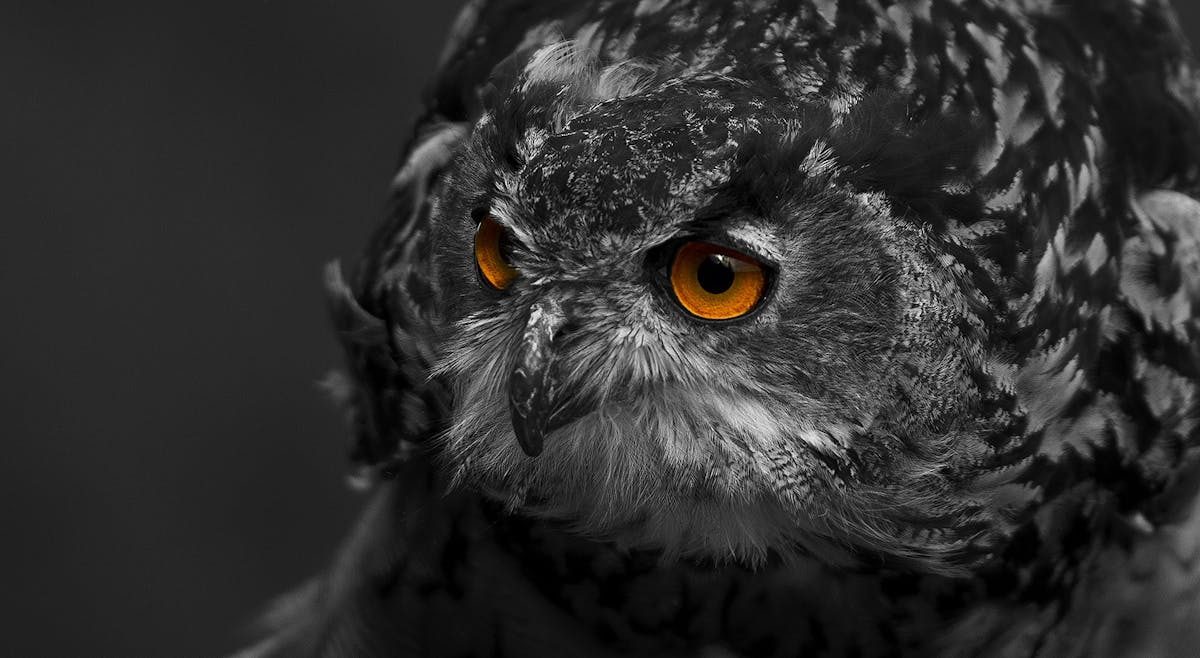
The large, round eyes that gave ancient observers the impression of solemn thought are an optical adaptation, nothing more. Large pupils gather more light in low-light environments. Forward-facing placement creates overlapping visual fields that enable depth perception. The owl staring back at you from a branch is not pondering your worth. It is deciding whether you are a threat to its meal.
Owl Myths About Darkness and Vision
The myth that owls can see in complete darkness persists partly because owls are so good at what they do in dim conditions. A barn owl can successfully locate and catch prey in light levels roughly 100 times lower than what a human eye needs. In field conditions this seems almost magical, but the mechanism has limits: no eye can form an image from truly zero photons.
Owl eyes are packed with rod cells, which detect low-intensity light, and are proportionally enormous. In some species the eyes weigh more than the brain. The pupils can open extremely wide, gathering every available photon. A reflective layer behind the retina, the tapetum lucidum, bounces light back through the photoreceptors for a second pass, effectively doubling sensitivity.
Hearing fills the rest of the gap. The barn owl’s asymmetrically placed ears capture sounds arriving at slightly different times, allowing the brain to triangulate prey position in three dimensions. This system is so accurate that barn owls hunting in laboratory tests have caught mice under a thick layer of leaves in conditions where the mice made no visible movement at all. The owl was navigating entirely by sound. That is less mystical than seeing in darkness, perhaps, but it is considerably more impressive as a piece of engineering.
The Omen Myth: Owls and Death
Across many cultures, hearing an owl call at night was taken as a sign that someone nearby would die. This belief appears in ancient Roman accounts, in various Native American traditions, in parts of Africa, and across rural Europe. It persisted so stubbornly that some people still feel a small chill when they hear a hoot at the wrong hour.
The origin is straightforward. Owls are nocturnal, they appear suddenly and silently, and many species produce calls that sound unsettlingly human, the barn owl’s shriek in particular. In pre-electric communities where darkness meant real danger, an invisible creature screaming from the trees was easy to link to misfortune. It was pattern recognition applied to fear, not observation of cause and effect.
The grain of truth is that barn owls and other species do sometimes roost in or near buildings, particularly barns, old churches, and abandoned houses, places where a community would gather. Someone sick or elderly spending a final night in such a building might genuinely have an owl perched overhead. The proximity was coincidence, not causation. You can read more about how cultural attitudes shape our relationship with wildlife in the article on wolf myths and danger perceptions.
The All-Night Myth: Are Owls Always Nocturnal?
Most owls are indeed most active after dark, but the category is not as uniform as the stereotype suggests. The burrowing owl hunts insects and small mammals during daylight hours and is regularly seen perching at the entrance to its burrow in full sun. The short-eared owl is crepuscular, most active at dawn and dusk, and readily hunts in open daylight when prey is available or when day length at high latitudes leaves little alternative.
The snowy owl of the Arctic is perhaps the most dramatic exception. Breeding in regions where summer produces 24-hour daylight, snowy owls simply cannot be nocturnal and survive. They hunt lemmings around the clock. When snowy owls migrate south in winter irruption years, they appear on open fields and beaches in broad daylight, to the considerable excitement of birders who suddenly find a white owl sitting on a fence post at noon.
Even firmly nocturnal species sometimes emerge earlier on cloudy days or become visible during hard winters when hunting opportunities are limited. The takeaway is that owls are flexible, not rigidly locked to darkness. If you see one in daylight, it is not sick or confused. It is doing what the situation requires.
Owl Myths About Attacking Humans
The internet has made famous a handful of incidents in which owls struck people from behind, usually during jogging or hiking near woodland edges. In several cases these attacks recurred with the same individual and the same owl over a stretch of weeks. This sounds alarming, but context matters considerably.
The overwhelming majority of owl-human contact incidents happen within a short radius of an active nest during the breeding season, roughly March through June for most North American species. Great horned owls are the most reported offenders, because they are large, common, and aggressively territorial when raising young. A person walking the same path night after night during nesting season may genuinely be perceived as a recurring threat.
Outside of nesting season and active nest sites, owls essentially ignore people. The risk is real in the same way that any protective parent represents a risk when you wander into their immediate space, but it is not a reason to fear owls generally. Wearing a hat with eyes drawn on the back is a genuinely recommended measure in areas with known nesting great horneds, since owls tend to approach from behind. It works because owls prefer not to be seen during an approach.
What Owls Actually Are
Strip away the mythology and what remains is a group of roughly 250 species that have independently arrived at some of the most refined sensory adaptations in the bird world. They fly almost silently, thanks to comb-like leading edges on their primary feathers that break up turbulence before it can generate sound. They can hear a mouse moving under snow. They locate prey in darkness that would render most predators helpless.
Owls also play a measurable role in controlling rodent populations. A single barn owl pair raising two clutches in a year can consume more than a thousand rodents. Farmers who install nest boxes on their properties have documented real reductions in crop damage without any use of rodenticides. This is the kind of concrete ecological value that no mythology needed to invent, because it was always there.
If you want to actually see owls rather than just theorize about them, the best approach is patient listening. Learning three or four species calls in your region puts you ahead of most casual observers. A calm walk through woodland at dusk, stopping to listen every few minutes, will eventually produce results. The owl is usually there before you know it.