Anúncios
Of all the myths attached to the animal kingdom, the image of an ostrich pushing its head into the ground to hide from trouble has had an extraordinary run. It shows up in cartoons, political speeches, business metaphors, and proverbs across dozens of languages. The phrase is so useful for describing avoidance behavior in humans that people keep reaching for it. There is just one problem: ostriches do not do this, and they never have.
Where This Myth First Appeared
The head-in-sand story is old. The Roman author Pliny the Elder, writing in the first century, described ostriches hiding their heads in bushes and believing themselves hidden. He was likely working from secondhand reports, the way ancient naturalists often did, and the image was compelling enough that it traveled forward through centuries of natural history texts.
Anúncios
By the time printing presses made books widespread, the claim had been repeated enough times to carry the weight of established fact. Later illustrators drew ostriches with heads underground, and those images circulated for generations before anyone with a serious interest in African wildlife thought to check carefully. By then, the myth was embedded in language itself.
The classical writers were not entirely inventing things. Ostriches do lower their heads dramatically, as explained below, and a person watching from a distance in poor visibility could plausibly misread what they saw. But misread they did.
Anúncios
What Ostriches Actually Do Near the Ground
Ostriches are ground-nesting birds. They scrape a shallow depression in the earth, and both parents take turns sitting on the eggs during incubation. Throughout the nesting cycle, the birds regularly lower their heads to the nest level to turn eggs, check the clutch, and settle into position. This involves the long neck of an ostrich bending fully downward until the head is at or very near ground level.
From a distance across open savanna, with haze and heat shimmer distorting the view, that posture can look exactly like a head disappearing into the earth. The legs and body remain visible, and the neck appears to simply end. The illusion is convincing enough to have fooled observers for millennia. Add to this the dusty, pale color of the sandy soil in ostrich habitat, which blends with the bird’s lower neck, and you have all the ingredients for a persistent misidentification.
Ostriches also dip their heads while feeding, picking up pebbles (which aid digestion), investigating smells, and drinking. Each of these behaviors involves the head going low and sometimes forward, which contributes to the general impression that ostriches spend time with their heads aimed at the ground.
The Actual Defense Strategies of an Ostrich
An animal that responded to threats by burying its head would not survive for long. Ostriches have thrived across African savannas for millions of years, and their actual threat responses are well matched to their environment.
Running is the primary strategy. An ostrich in full sprint reaches speeds that outpace most predators, and they can sustain that pace for considerable distances. Their stride length is extraordinary, covering up to four and a half meters in a single step. Lions, the main predator that shares their habitat, can reach higher top speeds in short bursts but cannot match an ostrich over longer ground.
When flight is not possible, ostriches drop to the ground and press their necks flat, using their natural coloring to blend with the surrounding earth. This behavior, called crouching or lying flat, genuinely reduces their visibility to distant predators and is almost certainly another source of the head-burying story. A crouched ostrich with its neck flat on pale sand genuinely can be hard to see from certain angles.
When cornered, an ostrich kicks. The legs of an adult ostrich are powerful enough to deliver a fatal blow to a lion. Each foot has two toes, one bearing a long, hard claw pointing forward, and the force concentrated through that claw is considerable. As with large predators, the danger from ostriches is easily overestimated in some situations and underestimated in others; a calm, free-ranging ostrich is not a threat, but a cornered or nesting one is genuinely dangerous.
The Sensory Life of an Ostrich
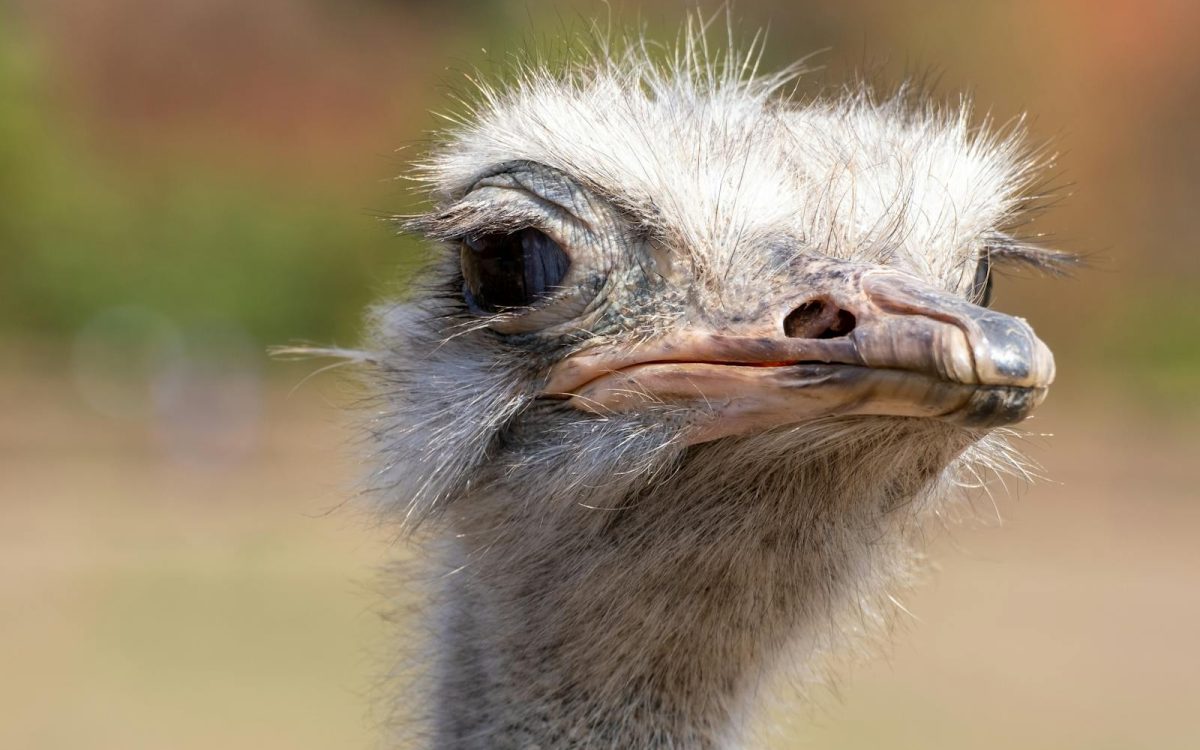
One of the reasons the head-in-sand story is so biologically absurd is that ostriches are, in fact, exceptional at detecting danger. Their eyes are roughly the size of a billiard ball, making them the largest eyes of any land animal on Earth. That size translates directly to visual acuity at range. An ostrich can detect movement at considerable distances across flat terrain, which is a major reason why other savanna animals such as zebras, wildebeest, and gazelles sometimes graze in proximity to ostriches. The birds serve as early warning sentinels.
An animal with eyes like that has no reason to hide them underground. The entire evolutionary logic of the ostrich points toward hypervigilance, not avoidance. Their height advantage, standing up to two and a half meters tall, combines with their visual acuity to make them one of the better early-warning systems on the African plains.
Their hearing is also sharp. Ostriches have prominent ear openings on the sides of their heads, and they orient toward sounds quickly. This full sensory investment in detecting the world around them is about as far from the hide-your-head strategy as an animal can get.
The Metaphor Lives On and Why It Matters
The phrase “burying your head in the sand” has become entirely disconnected from actual ostrich behavior. People use it to describe denial, avoidance, and ignoring problems, and the metaphor is vivid enough that it will probably persist regardless of what ostriches actually do. Language has a way of outlasting its source material.
That said, there is something mildly unfortunate about an animal becoming the universal symbol for cowardice and self-deception when its actual behavioral repertoire includes sprinting at 70 kilometers per hour and kicking lions hard enough to kill them. The ostrich deserves a better reputation than the myth has given it. Many animals carry reputations that do not match their biology, and the ostrich is one of the more vivid examples.
A Simple Rule for Myth-Checking
A useful question to ask about any animal behavior myth is: does this behavior make survival sense? An ostrich that responded to a stalking lion by pushing its head into the ground would be quickly eliminated from the gene pool. Evolution tends not to reward behaviors that make animals easier to catch and kill. When a claimed behavior seems to work directly against an animal’s survival, that is a strong signal to look more carefully at the evidence.
The actual ostrich behaviors, long-distance running, crouching flat, kicking when cornered, and vigilant scanning with exceptional eyes, all make obvious survival sense in a habitat full of large predators. The myth makes none. Animals adapt toward survival, not away from it, and that principle alone should have made people skeptical of the head-in-sand story centuries ago.
Next time you spot an ostrich lowering that long neck toward the earth, you are probably watching a devoted parent checking on eggs, an efficient forager picking up grit, or an alert animal investigating an interesting smell at ground level. The head is going near the ground, not into it, and the animal’s remarkable eyes are open the entire time.
See also: Do Goldfish Have a 3-Second Memory? Debunking a Classic.