Anúncios
Somewhere around a campfire or a school lunch table, you almost certainly heard the story. The daddy long legs, that fragile, long-legged creature picking its way across your garage floor, is supposedly the most venomous creature in the world. The only reason it has not killed anyone is that its fangs are too small to pierce human skin. The story is told with total conviction, usually by someone who heard it from someone equally certain. It is, in every important detail, false.
What the Daddy Long Legs Myth Actually Claims
The myth has two parts, and both need to be addressed separately because they fail for different reasons. The first claim is that daddy long legs carries a venom of extraordinary potency, sometimes described as the strongest of any spider or even any animal. The second claim is that this danger is kept harmlessly theoretical because the creature’s mouthparts are physically incapable of piercing human skin.
Anúncios
The venom claim has no credible scientific source. No toxicological study has found that any of the creatures commonly called daddy long legs produces a venom dangerous to humans. The fangs claim has a grain of structural truth in one specific case, which is probably how it became attached to the myth, but it is vastly overstated, and we will get to why shortly. The larger problem is that the myth treats a single name as though it refers to a single creature. It does not, and that confusion is the root of almost everything else that has gone wrong here.
The Identity Problem: Three Animals, One Name
The name daddy long legs is applied to at least three different animals depending on where you are standing when you use it. In most of North America and the United Kingdom, it primarily refers to the harvestman, an arachnid in the order Opiliones. In the United Kingdom it also commonly names the crane fly, a long-legged flying insect from the family Tipulidae. And in parts of North America, the cellar spider, Pholcus phalangioides, picks up the same nickname.
Anúncios
These three animals are not closely related. The crane fly is an insect, a completely different class of arthropod from arachnids. The harvestman and the cellar spider are both arachnids, but they belong to separate orders and their similarities are roughly equivalent to the similarities between a cat and a raccoon: both are mammals, but that shared category tells you very little about their specific biology.
The myth almost certainly originated with the cellar spider, the one animal of the three that is genuinely a spider with actual venom. From there, the story likely migrated across the name to stick to whichever long-legged creature the teller happened to be looking at, which is usually a harvestman.
The Harvestman: No Venom, No Silk, No Problem
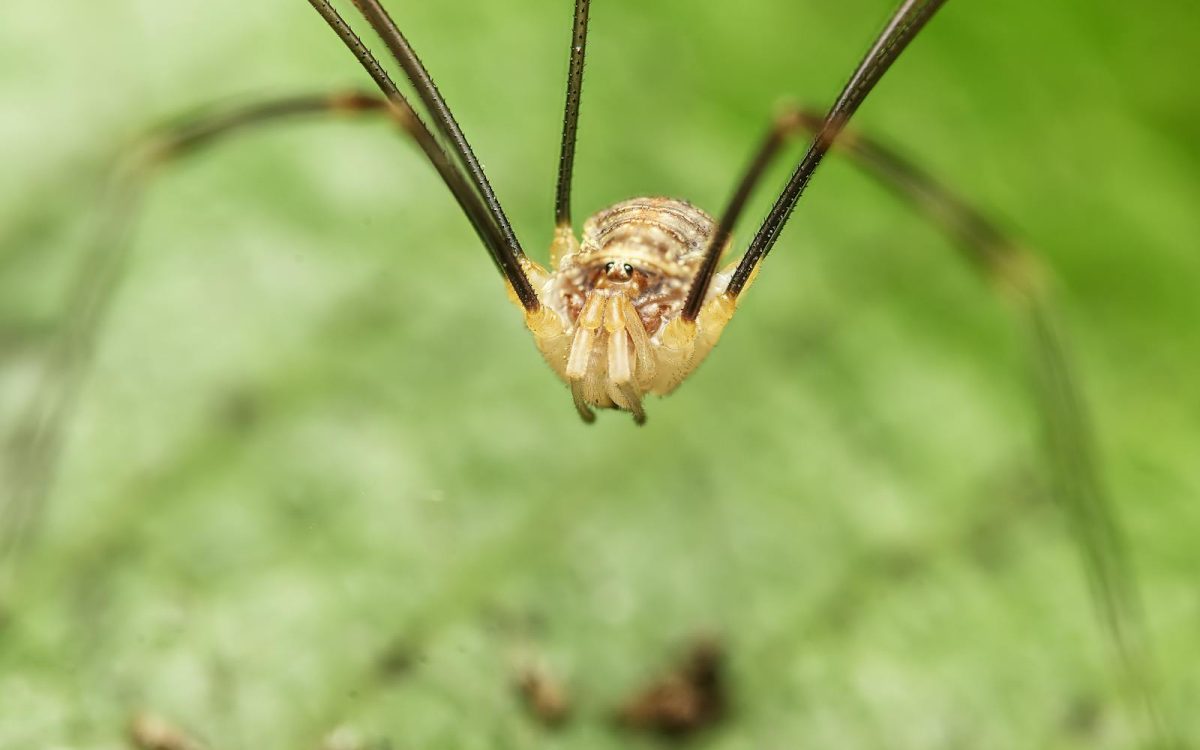
The harvestman is the creature most people encounter when they think of daddy long legs. You see them in gardens, on fence posts, and climbing across basement walls. Their body is a small, oval shape, legs extending outward like spokes of a bicycle wheel, moving with a slightly jerky, deliberate gait.
Harvestmen belong to the order Opiliones, not to the order Araneae, which contains true spiders. The differences are substantial. A spider has two distinct body segments, a cephalothorax and an abdomen, connected by a narrow waist. A harvestman has those segments fused into a single oval unit. Spiders produce silk. Harvestmen have no silk glands whatsoever. Spiders have venom glands and fangs. Harvestmen have no venom glands and no true fangs.
What harvestmen do have are chelicerae, small claw-like mouthparts used to manipulate and process food. These are completely unsuited to injecting venom into anything, because there is no venom to inject. They are detritivores and omnivores, feeding on decaying plant material, small insects, and fungi. Some species also appear to feed on bird droppings. They are among the more ecologically useful and completely harmless arachnids in any garden. You can learn more about which backyard creatures are actually worth welcoming in our piece on building a bug hotel for backyard insects.
The Cellar Spider: A Tiny Grain of Truth
The cellar spider is the animal that gives the myth its only real foothold. Unlike the harvestman, the cellar spider is a genuine spider with actual venom glands and fangs. It is commonly found in house corners and basement ceilings, where it hangs upside down in a loose, irregular web, and it does, in fact, sometimes prey on other spiders, including species larger and more imposing than itself.
This predatory behavior on venomous spiders probably contributed to the myth. The reasoning, never spoken but implied, is that if a creature can kill a black widow, it must be packing something formidable. That reasoning does not hold. Many animals prey successfully on venomous species through physical means, behavioral strategies, or resistance, not by out-venom-ing their prey.
In 2004, the television show MythBusters famously tested whether a cellar spider could bite a human host. The spider eventually bit, the host felt a mild, brief sting, and that was that. The venom of cellar spiders has been studied and found to be of no medical significance to humans. The chelicerae of cellar spiders are indeed relatively small for a spider of their size, which is the source of the fangs-too-short part of the myth, but the actual constraint is that the venom is mild, not that delivery is physically impossible. The fang size claim was, like much of the myth, an embellishment.
Why the Myth Persists
Myths about hidden danger survive because they are useful social tools. Telling a child that the harmless-looking creature on the wall is secretly the most deadly thing in the room explains, in a satisfying way, why they should leave it alone. The story does not need to be true to accomplish that goal. In fact, a story does not need to be verifiable at all to spread; it only needs to be memorable and slightly alarming.
The daddy long legs myth has one other advantage: it is unfalsifiable in the casual telling. The fangs-too-short clause preemptively explains away the absence of any evidence. Nobody has ever been hurt by one, goes the story, because the delivery system is broken. This structure makes the claim feel more believable, not less. It sounds like a scientific qualifier. In practice, it is the opposite: it is the feature that makes the myth impossible to disprove through ordinary experience.
Correcting it requires knowing that the venom claim was never grounded in evidence to begin with. An extraordinary claim about extreme toxicity requires extraordinary evidence. None has ever been produced, because the venom, in the harvestman’s case, does not exist, and in the cellar spider’s case, is genuinely mild.
The Real and Fascinating Biology
Harvestmen are worth knowing on their own terms, because the reality is genuinely interesting. They are among the oldest arachnids in the fossil record, with specimens dating back over 400 million years to the Devonian period. Some fossil harvestmen look remarkably similar to living species, suggesting their body plan is one of nature’s more successful long-running experiments.
Some species of harvestmen practice a behavior called autotomy: when grabbed by a leg, they can detach the limb and keep moving. The abandoned leg continues twitching for some time afterward, potentially distracting the predator. Unlike some lizards, harvestmen cannot regrow the lost limb, so the sacrifice is permanent, but it can mean the difference between escape and being eaten.
Many harvestmen also aggregate in dense clusters during cold weather, sometimes forming living masses of hundreds or thousands of individuals on the sheltered side of a tree or rock face. The function appears to be thermal regulation and, possibly, mutual defense through collective scent, as disturbed clusters release a chemical deterrent. These clusters look startling but are entirely harmless. You can explore the broader topic of how arachnids fit into backyard ecology in the article about spider myths and what is actually true.
What to Tell the Next Person Who Repeats the Myth
The short version is clean and easy to remember. The most common daddy long legs is a harvestman, not a spider, and it has no venom at all. The cellar spider, which sometimes gets the same name, does have venom, but it is mild and medically insignificant. No documented human fatality or serious injury has ever been attributed to either creature. The most venomous animal in the world is not lurking on your basement ceiling.
What actually is lurking there, if you are lucky, is a creature with a 400-million-year pedigree, remarkable self-defense tricks, and absolutely no interest in you whatsoever. That seems worth appreciating. The mythology was always less interesting than the animal.
See also: Snake Myths and Facts Everyone Gets Wrong.