Anúncios
There is a bench in a small urban park near where I used to live. It faces a single large lime tree and, behind it, a rectangle of sky. For a long stretch during a particularly grinding work period, I would sit there for fifteen minutes at lunch. I did not go to think or to exercise. I went to look at the tree. By the end of six weeks I could tell you the tree’s mood by the sound of its leaves and whether the sparrows using it were feeding or sheltering. That bench, that tree, and that small wedge of daily attention changed how I felt far more than anything else I was doing at the time.
Mindful time in nature does not require distance, gear, or fitness. It requires only a willingness to slow down and notice what is already there.
Anúncios
What Mindful Time in Nature Actually Means
The word “mindful” has been used so broadly that it has lost some precision. Here it means simple: being present with your senses rather than present only with your thoughts. When you walk past a hedge on autopilot, your mind is elsewhere and the hedge registers as background. When you walk past the same hedge with attention, you might notice the particular dry-paper smell of hawthorn in summer, the way a wren moves differently from a blackbird, the small web between two branches catching the light.
The distinction is not mystical. It is just the difference between passing through a place and actually being in it. Most of us, most of the time, pass through.
Anúncios
Choosing Where to Go
The best location is whatever outdoor space you can reach with minimal effort. Low friction is important, because a habit that requires planning rarely takes root. Your back garden, a small local park, a stretch of canal path, a churchyard, a roadside verge with a bench: all of these count.
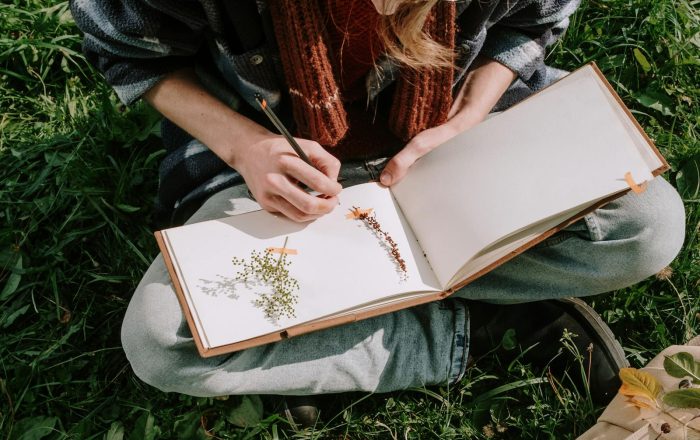
One useful strategy is to nominate a single spot you can return to repeatedly. A specific tree, a particular bench, a corner of a garden. Returning to the same place over time is one of the most effective ways to develop genuine nature awareness, because you build a baseline. Once you know what is normal for a place, you notice what changes, and change is where the interesting observations live. You might combine this with a simple nature journal to record what you find each visit.
Using Your Senses in Order
When you arrive at your spot, try moving through your senses deliberately rather than just looking around. Sound is a good place to start because it draws attention outward and downward into the environment rather than keeping it locked in thought. Close your eyes for sixty seconds and simply listen. Not to identify birds or name sources, just to hear the layers: what is nearest, what is furthest, what is constant, what is intermittent.
Then smell. Most adults have effectively stopped noticing outdoor scents except when they are extreme. Wet soil, dry grass, pine needles in sun, the faint sweetness of certain flowers: all of these are free and immediate if you simply pause and breathe through your nose.
Touch comes next: bark, a leaf between your fingers, the temperature of a stone or a railing, the feel of grass against the back of your hand. The physicality of contact with natural material is something our bodies respond to in ways we rarely make space for.
Then look, but look differently than usual. Try focusing on something within arm’s reach for a full minute before lifting your gaze to the middle distance. Notice color variation within what looks uniform: a single leaf is rarely one shade of green. Notice texture, movement, and shape before you notice category.
The Single-Object Practice
One of the most practical exercises for beginners is to choose a single natural object and observe it for five uninterrupted minutes. A pinecone, a lichen-covered stone, a patch of moss, a flower head, a handful of soil. This sounds either very easy or quite difficult depending on how settled your mind is, and that itself is information.
The practice trains the kind of patient attention that makes everything else in outdoor observation easier. People who can look closely at one small thing for five minutes tend to notice vastly more in open landscapes than people who scan habitually. Sustained attention is a learnable skill, and the single-object practice is a reliable way to build it.
Sitting Still vs Moving Slowly
Both are valid and both produce different results. Sitting still lets you become part of the landscape rather than a disturbance moving through it. After five to ten minutes of stillness, birds and small mammals often behave as though you are simply furniture. You see behaviors that moving observers never do: feeding rituals, territorial disputes, the way a fox tests the wind before crossing a gap.
Moving slowly, by contrast, covers more ground and exposes you to a greater variety of conditions, smells, and sounds within a single session. A pace of about half your normal walking speed is good for beginners. At that pace you can look at your feet, notice plant variety, watch insects, and observe bird movements in low vegetation.
The practice of slow birding combines these two modes well, and the skills overlap closely with general mindful nature observation.
What to Do With Thoughts That Intrude
Your mind will wander, especially at first. Work problems, shopping lists, social anxieties, plans: they all have a way of arriving precisely when you are trying to pay attention to something else. This is not failure; it is just what minds do.
The most practical response is to use an anchor: a specific sensory detail you can return your attention to whenever you notice it has drifted. The sound of a stream, the feel of a rough surface under your palm, the movement of a particular branch in the wind. Every time you notice you have drifted and return to the anchor, you have done something useful. The returning matters more than the staying.
Do not try to empty your mind. That is an unreliable goal even for experienced practitioners. Instead, aim to shift the ratio gradually: a little more time on the tree, a little less on the to-do list. Over weeks, that ratio does tend to shift on its own.
Nature Across All Weathers
A common barrier is the belief that outdoor time is only worthwhile in good weather. This belief costs people a great deal. Overcast days flatten light in ways that reveal color and texture differently than sunlight does. Fog changes sound and scale. Wind makes visible things, like the complex movement of a tree, that are simply invisible on still days. Rain brings out smell more than any other weather, and the animal behavior immediately before and after rain is often fascinating.
Dress for the conditions and go anyway. The version of a familiar place in unexpected weather can feel like a completely different place, and that disorientation tends to sharpen attention in ways that comfortable familiar conditions do not.
Through the seasons, each period has its own textures and rhythms. A season-by-season guide to nature can give you a sense of what to expect and what to look for as the year turns.
Making It a Regular Practice
The most important thing about mindful time in nature is not how long each session lasts or how dramatic the setting is. It is that you go regularly, with genuine attention, and that you let the practice be simple enough to sustain. Start with whatever you can manage this week. Ten minutes, three mornings, a spot close to home. Note what you notice, even informally. Return to the same spot. Let it grow from there.
The world is genuinely worth looking at. Most of us simply need a little permission and a little practice before we start to see it properly.