Anúncios
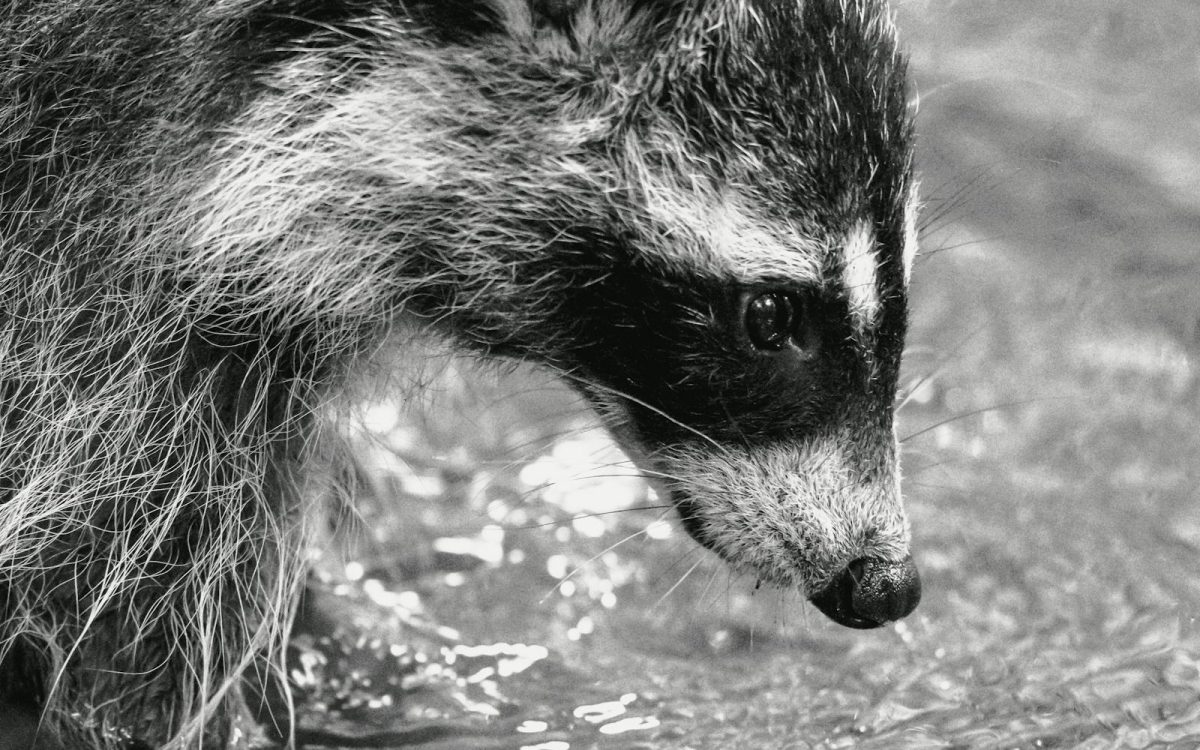
Watch a raccoon near a stream with a piece of food and you will almost certainly see it dip the food in the water, rub it around, and turn it over with those nimble front paws before eating. The behavior looks unmistakably like washing. It fits so naturally with what we know about hygiene that generations of observers simply named the behavior accordingly and moved on. The word for raccoon in several European languages is some version of “washing bear.” But the cleaning explanation turns out to miss the point entirely.
A Sensory System Built Into Their Paws
Raccoon forepaws are among the most sensitive tactile organs found in any mammal. The skin on their palms and fingers contains a remarkable density of mechanoreceptors, specialized nerve cells that respond to pressure, vibration, and texture. Per square centimeter, raccoon paw skin has roughly four times more sensory nerve endings than most comparable mammals. The tactile picture they build from touching an object is extraordinarily detailed.
Anúncios
This sensitivity is part of how raccoons identify food in the first place. They forage at night and in murky water where vision is limited, and their paws give them immediate, precise information about shape, texture, firmness, and movement. Crayfish feel different from smooth stones. Live frogs move differently from dead ones. The paws do the preliminary assessment that eyes might handle for a daytime forager in a bright environment.
When the skin is wet, it becomes thinner and more pliable, and thin, moist skin transmits mechanical information more faithfully than dry, slightly thickened skin. The act of wetting the paws before or during food handling is essentially a recalibration. The raccoon is turning up the sensitivity on a sensory system that is already excellent.
Anúncios
What the Captive Raccoon Studies Revealed
The cleaning hypothesis has a straightforward testable prediction: raccoons should wash food less, or not at all, when water is unavailable, because there is nothing to clean the food with. Researchers studying captive raccoons found something quite different. Animals in enclosures with no water access still performed the same rubbing and manipulating motions with their food, just without the water. The behavior did not disappear; it simply ran through its sequence without the wetting component.
This is a key observation. If the purpose were hygiene, removing water should eliminate or sharply reduce the behavior. Instead, the core motion, turning, rubbing, and examining food between the paws, continued unchanged. The water, when present, enhanced the process but was not the point of it. The point was the examination itself.
Raccoons also showed the wetting behavior with items that could not plausibly need cleaning: rocks, non-food objects, and already clean captive-provided food. This further separated the behavior from any cleaning function and pointed instead toward a sensory exploration pattern. They were not washing; they were reading.
The Evolutionary Logic Behind the Behavior
Raccoons originated in North American forests and have always lived close to water. Streams, ponds, and marshes are productive foraging grounds for them. Crayfish, frogs, fish, and freshwater mussels are among their preferred foods, and catching these requires working in or near water with both paws. An animal that forages primarily in water and wet substrates would, over time, be shaped by natural selection to get maximum information from its paws in wet conditions.
The enhanced-sensitivity-when-wet characteristic of their paw skin may have evolved precisely because most of their precision foraging happens in water. Getting the paws wet before handling food items on land could be a carry-over of the aquatic foraging behavior, and because the wet-paw state genuinely improves tactile data quality, it has been retained and reinforced.
Their diet breadth supports this interpretation. Raccoons are opportunistic omnivores that encounter a huge variety of food items, including many that are unfamiliar or of uncertain quality. A detailed tactile examination before eating is genuinely useful when you regularly handle novel items. A specialist feeder eating the same prey day after day needs less preliminary assessment. A generalist benefits from thorough pre-ingestion evaluation.
How This Connects to Raccoon Intelligence
The sensory sophistication of raccoon paws pairs with a brain that is unusually capable for a non-primate. Studies placing raccoons in problem-solving scenarios have documented their ability to memorize multi-step solutions for years, apply learned skills to novel problems, and adapt their behavior in response to changing conditions. This cognitive capacity is part of what makes raccoons so successful in urban environments, where they face constantly changing challenges and novel food sources.
Their paws and their brains appear to work together in a unified system for environmental investigation. Pick up an unknown object, feel it carefully with moistened paws, process the rich tactile data in a capable brain, and make a decision about whether it is worth eating, playing with, or ignoring. Urban raccoons apply this same system to garbage bins, latches, compost containers, and anything else that might yield a meal.
The tactile examination also has a strong behavioral component that goes beyond individual food items. Raccoons manipulate objects in general with a curiosity and persistence that suggests active exploration of their environment. This is not random fiddling; it appears to be information gathering of a broad kind, building a tactile map of the world through direct contact.
A Word About the German Name
The scientific name for the common raccoon is Procyon lotor. That species name, lotor, is Latin for “washer” and was assigned by the naturalist Gottlieb Conrad Christian Storr in the eighteenth century, based on the same observation that gave rise to the German name Waschbar. The washing interpretation was the obvious one for observers of the time, and it stuck deep enough to make it into the scientific classification that still stands today.
This is a reminder that early natural history was often accurate in describing what animals do while being wrong about why they do it. The behavior was correctly observed; the function was misread. Science has a long history of revisiting old observations with new tools and finding that the explanation needs updating even when the description was right.
Does the Food Ever Get Genuinely Cleaned?
There is a small practical side note worth including. Raccoons that forage in genuinely muddy substrates do sometimes handle food items that have visible debris on them, and the dipping and rubbing motions probably do remove some surface material in passing. So the cleaning effect is not zero. But this is incidental to the purpose of the behavior, not its driver. Animals adapting to varied environments often show behaviors that serve multiple functions, and it is possible that in some contexts raccoon food-wetting has a modest cleaning benefit alongside its primary sensory function.
What it is not is a sign of fastidiousness, a preference for clean meals, or a human-like concern with food hygiene. Raccoons that happily eat garbage, carrion, and decaying organic matter are not especially worried about germs on their crayfish. The water is a sensory tool, not a sanitation step.
Raccoons remain one of the more misunderstood mammals in North America, primarily because they are common enough for everyone to have opinions about them but rare enough in close observation that those opinions are often based on incomplete information. Their paw sensitivity alone deserves far more attention than the washing myth has managed to attract, because it represents a genuinely remarkable piece of sensory biology hiding in plain sight at the edge of every stream and pond where raccoons forage after dark.
See also: The Daddy Long Legs Myth, Finally Explained.