Anúncios
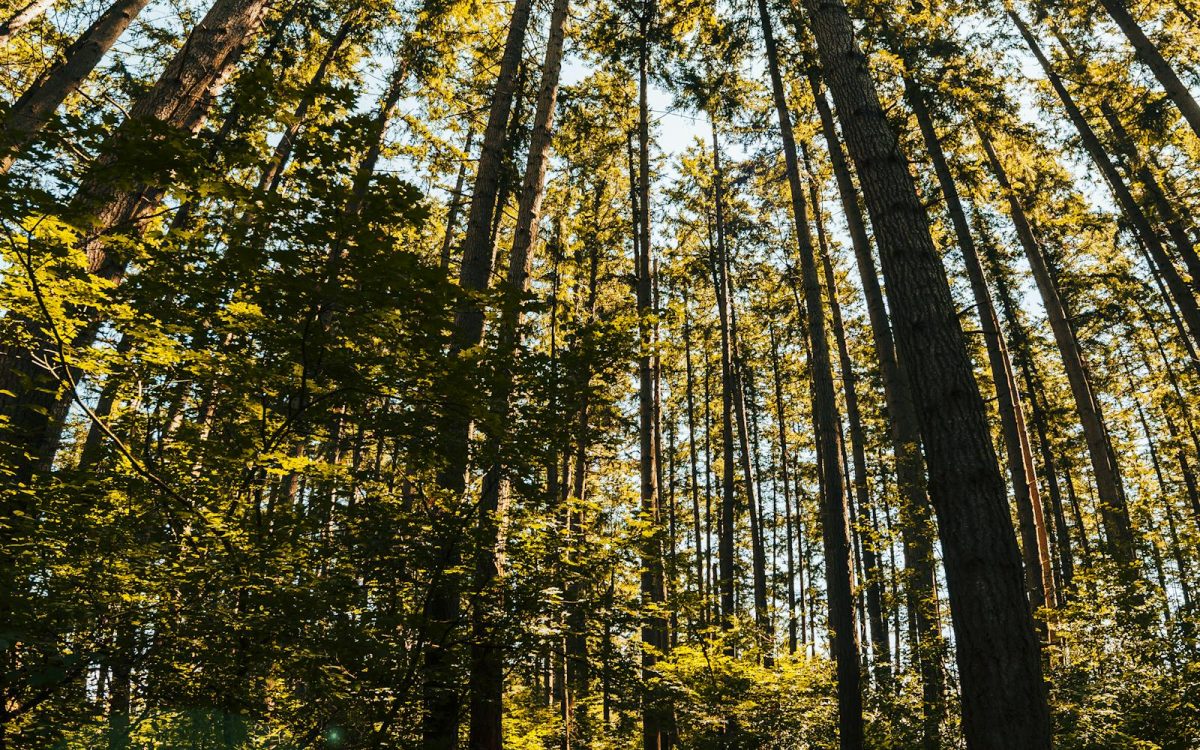
A forest asks nothing of you. It does not care how fast you walk or how much you know about the names of trees. The moment you step under a canopy and let the ambient noise of the human world soften behind you, something in the body begins to shift. Forest bathing is simply the practice of letting that shift happen, slowly and on purpose.
Where Forest Bathing Comes From
The term shinrin-yoku was coined in Japan in 1982 by the country’s Forestry Agency as part of a public health initiative. The translation is close to forest atmosphere bath, a phrase that captures the passive, receptive quality of the practice: you are not conquering a trail or cataloguing species. You are soaking in an environment the way you might soak in a warm bath, letting it do its work without effort on your part.
Anúncios
Japanese researchers, particularly those at Nippon Medical School, spent years studying what actually happens physiologically when people spend quiet time in forests. They found consistent reductions in cortisol, the primary stress hormone. They found lower blood pressure, slower heart rate, and improved scores on mood and anxiety measures. Perhaps most intriguingly, they found increases in natural killer cell activity, a component of the immune system that responds to viral infections and abnormal cells. The trees are not magic; the mechanism appears to involve phytoncides, the volatile organic compounds that conifers and other trees release into the air, which have measurable effects on human biology when inhaled over time.
What Forest Bathing Actually Looks Like
If you have ever walked through a woodland and found yourself pausing to look at light filtering through leaves without quite knowing why you stopped, you have already had a taste of it. A deliberate forest bathing session simply does that more consciously and for longer.
Anúncios
You walk slowly, far more slowly than your usual pace. You might cover half a mile in an hour. You stop frequently, not because you are tired, but because something catches your attention: the way moss covers one side of a rock, the layered smell of damp earth and pine resin, the specific quality of birdsong from a hidden spot above you. You might crouch to look at something small. You might stand still long enough that a squirrel forgets you are there.
The practice pairs naturally with mindful time in nature: both ask you to leave goal-oriented thinking at the trailhead and simply be present in a living place.
How to Set Up Your First Session
Choose a location with trees and relatively little human noise. It does not need to be wilderness. A city park with mature oaks, a riverside trail lined with willows, or a fragment of woodland at the edge of a suburb all work. The key quality is an environment where your senses have something natural to settle on.
Set a gentle intention before you begin: you are not going to cover ground or reach a destination. Leave your earbuds behind. If you feel you must bring your phone, put it on silent and in a pocket rather than in your hand. Give yourself at least 45 minutes, though longer is better.
Begin by standing still for a couple of minutes just inside the treeline. Notice what you can hear. Layer the sounds: what is closest, what is furthest away, what is moving and what is constant. Then begin to walk, but follow your curiosity rather than a route. If a mossy log invites you to sit for ten minutes, sit. If you want to press your palm to the rough bark of a mature tree, do so. The only task is noticing.
Engaging Your Senses One at a Time
Most of us move through even beautiful landscapes in a fairly narrow perceptual band. Forest bathing asks you to broaden it deliberately. Spend a few minutes with each sense in turn.
Touch: place your hand on the ground, on bark, on a leaf. Notice the difference in temperature, texture, and moisture. Smell: crouch close to earth after rain, hold a crushed leaf near your nose, breathe deeply near a conifer. Taste: unless you are confident in plant identification, do not eat anything, but notice the taste of the air itself, whether it carries sweetness, sharpness, or the mineral edge of a stream nearby. Hearing: close your eyes for a minute and simply listen without labelling. Sound: let sound arrive rather than reaching out to identify it. Sight: try focusing on the space between things rather than the objects themselves, the gaps in leaves, the air between trunks.
Many people find that after 20 or 30 minutes of this kind of attention, a quiet mental clarity arrives that feels noticeably different from ordinary relaxation. It is not sedating; it is clarifying.
What the Research Actually Shows
The evidence base for forest bathing has expanded considerably since the early Japanese studies. A 2019 analysis published in the journal Environmental Health and Preventive Medicine reviewed data from over 20,000 participants and found that people who spent at least 120 minutes a week in natural settings reported significantly better health and wellbeing than those who spent no time in nature. Two hours was the threshold where benefits became consistent, and it did not matter whether that time was taken in one long session or spread across shorter ones.
Separate research from the University of Michigan found that even a 20-minute walk in a park-like setting reduced cortisol levels in students significantly. The studies are not all perfect in design, and researchers are still teasing apart exactly which components of nature exposure drive which effects. But the direction of the evidence is clear: spending quiet time among trees does something measurable and beneficial to the human body and mind.
Making Forest Bathing a Regular Practice
A single session is restorative. A regular practice is transformative. People who build forest time into their weekly routines often report that they begin to notice changes in their baseline: less reactive to stress, more aware of beauty in ordinary places, more patient. These are not mystical claims; they reflect what happens when the nervous system gets regular practice at being in a low-threat, sensory-rich environment.
You do not need a spectacular forest. The same pocket of trees visited every week in different weather and different seasons becomes a deeply familiar place, and familiarity with a piece of nature is its own reward. You will notice which birds are there in February that are gone in July. You will find the spot where bluebells come up first each spring. You will know, without thinking, when the season has turned.
Some people combine forest time with nature journaling, writing a few lines or sketching something small after each session. Others prefer to keep it purely physical and sensory. Either way works. The practice belongs to you.
Find your nearest patch of trees this week. Go slowly, go quietly, and stay longer than feels strictly necessary. That lingering is exactly the point, and what you take home with you will cost nothing except the time you gave.
See also: How to Raise Kids Who Love Nature.