Anúncios
Few pieces of wildlife misinformation have been repeated as confidently, or for as long, as the story of lemmings throwing themselves off cliffs in waves of collective suicide. The image is vivid enough that it became a metaphor for mindless group behavior, a verb in casual conversation, a video game series, and a persistent staple of nature documentaries for decades. It is also, in its dramatic form, entirely fabricated. What makes this particular myth worth examining is that we know exactly where it came from, and the story of its creation is arguably more interesting than the fiction itself.
The Lemming Myth and Its Specific Origin
In 1958, Walt Disney Productions released a nature documentary called White Wilderness, part of a True-Life Adventures series that won considerable praise and multiple Academy Awards. The film covered the Arctic and included a now-infamous sequence showing lemmings in apparent mass hysteria, swarming in huge numbers, then launching themselves off a cliff into churning water below.
Anúncios
The sequence was staged. Canadian investigative journalist Brian Vallee and a CBC documentary team reported in 1982, more than two decades after the film’s release, that the lemming footage was fabricated. The filmmakers had bought lemmings from Inuit children in Manitoba and transported them to a location near Calgary, which is nowhere near lemming habitat. A snow-covered turntable was used to make a small number of lemmings appear to be a massive surging herd. Then some of the animals were herded off a riverbank into the water below while cameras rolled.
The film won the Academy Award for Best Documentary. The staging was not reported until the animals had been dead for decades and the myth had already embedded itself in popular culture. By then, the image of the suicidal lemming was already being used as a metaphor in political speeches, business writing, and everyday conversation. The film had done its work.
Anúncios
What Lemmings Actually Are
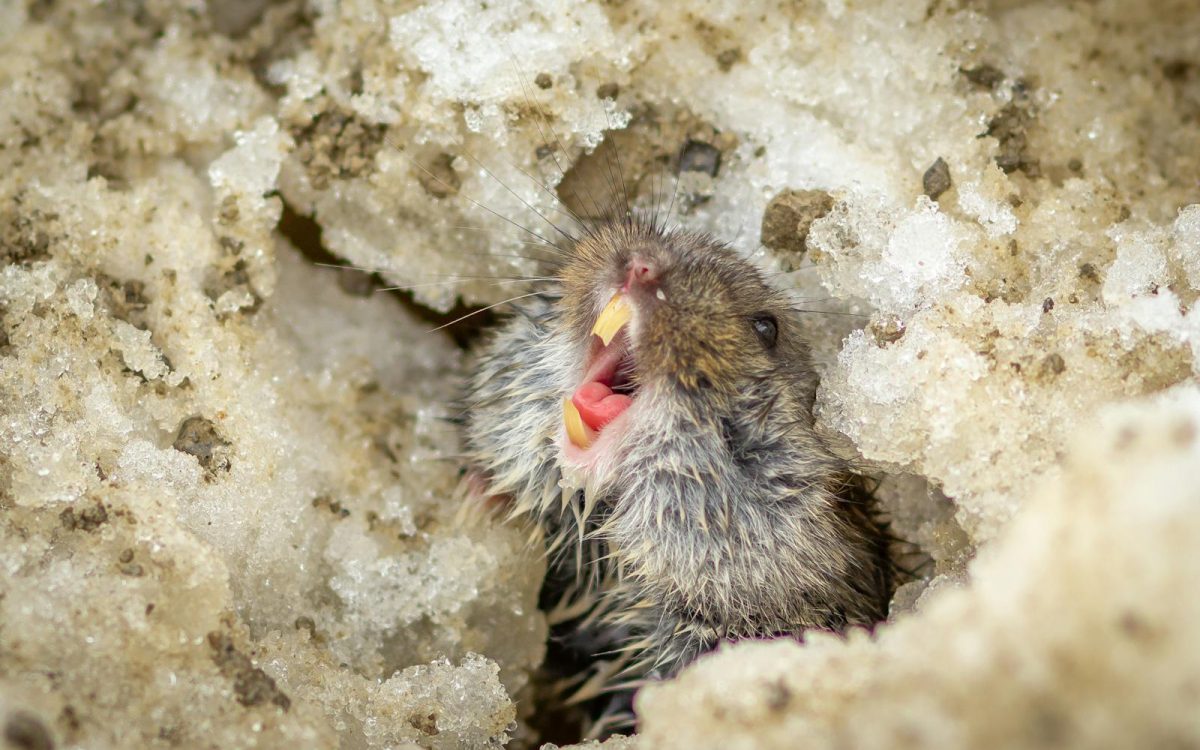
Lemmings are small rodents of the subfamily Arvicolinae, closely related to voles. Several species live across arctic and subarctic regions in North America, Europe, and Asia. They are compact, thick-furred animals, rarely more than about five inches long, designed for life in tundra and boreal environments where temperatures drop to extremes. Unlike many arctic animals, lemmings stay active throughout winter, tunneling under the snow where temperatures are more stable and food in the form of roots, mosses, and sedges remains accessible.
They are prey animals of considerable ecological importance. Snowy owls, arctic foxes, rough-legged hawks, and several mustelid species build their breeding strategies around lemming availability. In high lemming years, snowy owls raise dramatically larger clutches. In crash years, many of these predators skip breeding entirely or, in the case of snowy owls, disperse south in search of alternative prey. The irregular appearances of snowy owls in the continental United States during winter, called irruption events, are closely tied to lemming population collapses in the north. You can read more about how predator populations track their prey in our piece on predator and prey relationships.
The Real Science of Lemming Population Cycles
The aspect of lemming biology that probably gave rise to the cliff myth, or at least made it seem plausible, is the genuine phenomenon of boom-and-bust population cycles. In favorable conditions, lemmings reproduce rapidly. A female can produce several litters in a single year, each containing multiple young, and those offspring can themselves begin reproducing within weeks. When food is plentiful and predator numbers have not yet caught up, populations can expand to remarkable densities in a matter of months.
Then the cycle reverses. High density stresses food resources, parasites and disease spread more easily, and the predator population, which has been growing in response to the prey abundance, begins to take a serious toll. Population crashes can be steep and fast. In some recorded cycles, Norwegian lemming numbers have fallen by 90 percent or more in a single year.
During population peaks, lemmings do disperse widely, moving outward from crowded areas in search of food and territory. These are not orderly migrations but opportunistic individual movements. Large numbers of animals moving through unfamiliar terrain naturally encounter obstacles: rivers, lakes, fjords. Some individuals attempt to cross and drown. This is not voluntary death or collective behavior. It is the ordinary hazard of small prey animals moving through terrain with water in it. Fish, birds, and other opportunists feed well during these events. The lemmings that successfully cross water reach new territory and the cycle continues.
Why the Myth Proved So Durable
The suicidal lemming idea had advantages beyond the Disney footage. It fit neatly into a way of thinking about nature that was common in the mid-twentieth century, a period when population regulation was sometimes explained in terms of animals acting for the good of the species, sacrificing themselves to prevent overpopulation. The concept of group selection, the idea that animals might behave in ways that harm the individual but benefit the group, was taken more seriously in popular science writing of that era than it is today. A lemming hurling itself off a cliff to reduce population pressure seemed, in that framework, like nature’s harsh but logical solution.
Modern evolutionary biology is skeptical of pure group selection explanations for individual behavior. Natural selection generally favors traits that benefit the individual carrying them. An animal genetically predisposed to kill itself during resource crunches would leave fewer descendants than one that dispersed, hid, or switched to different food. The suicidal lemming makes no evolutionary sense, which is one of several reasons biologists dismissed the idea even before the Disney fraud was exposed.
The metaphorical utility of the image also helped it survive scrutiny. Calling someone a lemming, meaning someone who blindly follows the crowd to disaster, is just too rhetorically convenient to give up easily. The myth served the metaphor, and the metaphor kept the myth alive.
The Ecology Around Lemming Cycles
One of the most remarkable things about lemming population cycles is the ripple effect they send through entire ecosystems. The roughly three-to-five-year cycle that characterizes Norwegian lemmings and some other species creates synchronized pulses of predator abundance and scarcity. When lemmings are high, the tundra is alive with foxes and owls. When lemmings crash, those predators switch to alternative prey, often with significant consequences for the animals they then target.
Plant communities are also affected. High lemming densities during winter result in heavy grazing of mosses, sedges, and other low vegetation under the snowpack. When the snow melts, areas of intense lemming activity can look dramatically altered, with tunnels and runways revealing the extent of their feeding. This disturbance, paradoxically, can stimulate plant growth in the following season by exposing soil and increasing nutrient availability.
The study of lemming cycles has contributed significantly to our understanding of how ecosystems function as connected, dynamic systems. The fact that one small rodent species can drive the breeding success of multiple raptor and predator species, alter vegetation structure, and influence prey populations across a broad food web is a reminder of how tightly ecology links seemingly separate elements. You can explore how these connections work more broadly in our guide to food chains and food webs.
What the Real Population Crashes Look Like
Researchers who have studied Norwegian lemming cycles closely describe crash years as strangely quiet. Where a peak year might see lemmings visible in every meadow and predators following close behind, a crash year produces a landscape that seems almost empty. The lemmings are largely underground, reduced to a fraction of their peak numbers, and the predators have dispersed or failed to breed.
The mechanism of the crash is still debated. Predation, food depletion, disease, and social stress from overcrowding have all been proposed, and current research suggests the crash is probably driven by a combination of these factors working together. The remarkable regularity of the cycle, and why it holds so consistently across species and geography, remains one of ecology’s more intriguing open questions.
What is settled, with complete confidence, is that voluntary cliff-diving is not part of the picture. Lemmings are survivors. They have successfully navigated arctic winters, population swings, and a relentless predator community for millions of years. They managed all of that without any help from dramatic self-destruction.
The next time the metaphor comes up in conversation, the genuine story is more interesting anyway: a small, tough, winter-burrowing rodent whose population cycles drive the entire arctic food web, whose numbers can swing from thousands to nearly zero and back in a matter of years, and whose actual dispersal behavior was mistaken for something it was not by filmmakers who found the real story insufficiently cinematic.
See also: Owl Myths and Facts, Beyond the Head-Turning.